Průhonice Castle, Renaissance Revival castle in Průhonice, Czech Republic
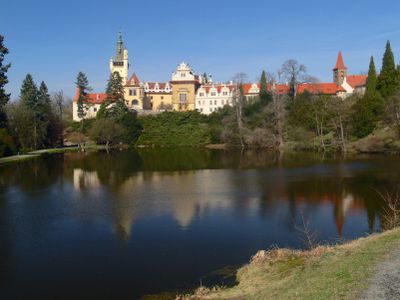
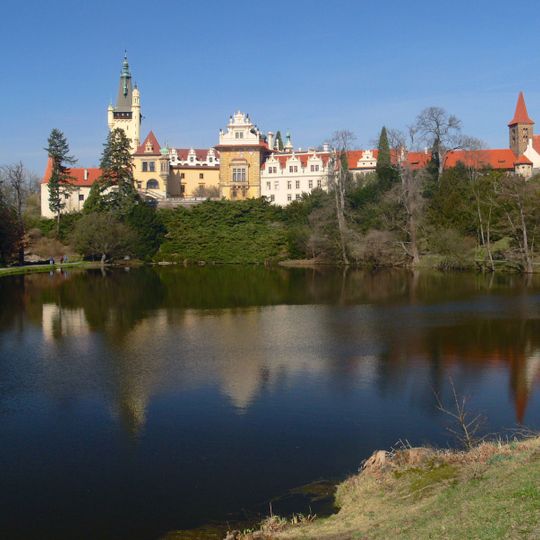
Průhonice Castle is a Neo-Renaissance château of pale yellow and cream walls under red-tiled roofs, standing behind a pond on a green slope. On the left a tall square tower carries a dark spire and clock; to its right a gabled wing with a steep red roof rises above an arched entrance, followed by a long white facade with rows of windows and a taller pedimented central section, and a round tower with a conical red roof at the far right.
A Gothic fortress of the lords of Říčany stood here from the 14th century; the Zápský family rebuilt it as a Renaissance château after 1508, and the Jesuits began a three-wing reconstruction in 1669. Count Jan Nepomuk Nostitz-Rieneck had it rebuilt in Classicist style in 1802, and from 1889 to 1894 Arnošt Silva-Tarouca gave it its Neo-Renaissance form, with a raised tower and Renaissance gables.
The castle has appeared in Czech films, among them the fairy tales S čerty nejsou žerty, Ať žijí duchové!, Arabela, Princezna se zlatou hvězdou and Třetí princ, and the 1996 Kouzelný měšec directed by Václav Vorlíček. Its courtyard and wings are the parts seen on screen.
The castle itself is not open to the public; the park around it is open daily and is crossed by a network of footpaths almost 40 km long. The Botanical Institute of the Czech Academy of Sciences, based in the castle since 1962, looks after the grounds.
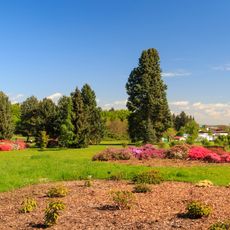
The castle interiors are closed to the public, but the grounds hold one of Europe's largest arboreta, with around 8,000 woody plants in 1,500 species and varieties, including some 100 rhododendrons and a three-hectare alpine garden. The park was begun in 1885 by Count Ernst Silva-Tarouca with botanist Camillo Schneider.
The community of curious travelers
AroundUs brings together thousands of curated places, local tips, and hidden gems, enriched daily by 92,324 contributors worldwide.