Červený Hrádek Castle, Baroque château in Červený Hrádek, Czech Republic.
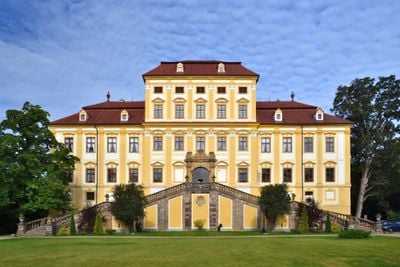
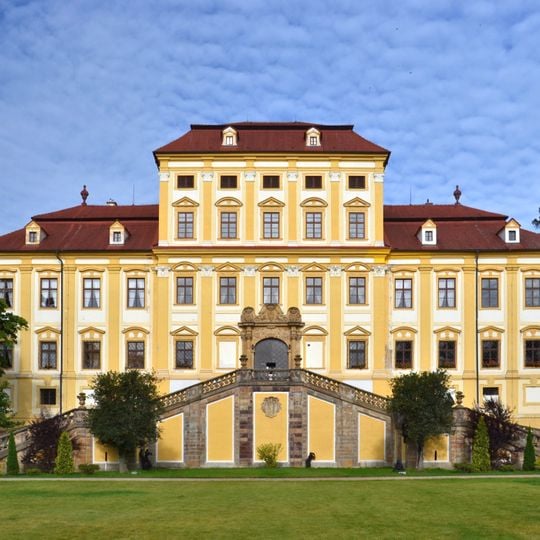
Červený Hrádek Castle is an early Baroque building with a yellow facade and red tiled roofs, its central block rising three storeys under a hip roof with dormers and three finials. Two lower yellow wings with red roofs extend left and right, the facade divided by pilasters and rows of rectangular windows. A stone balustraded staircase climbs to a central entrance crowned by a carved stone cartouche, with a coat of arms above a doorway on the landing.
A castle called Borek stood here before 1413, built perhaps by Dětřich Kraa, who held it as a fief from King Wenceslaus IV from 1415. Hussites burned it in 1421; after rebuilding under Václav z Moravěvsi it was painted red, giving the name Červený Hrádek, first recorded in 1422. Bohuslav Felix of Lobkowicz had it rebuilt as a Renaissance château after 1579, and Jan Adam Hrzán had the present early Baroque castle built between 1655 and 1675, probably to a design by Antonio della Porta.
The name Červený Hrádek (Red Castle) comes from the red paint applied to the castle after the Hussites burned it in 1421; the name first appears in written sources in 1422. In 1591, after a revolt in Chomutov against forced re-Catholicisation, two rebel burghers were executed at the castle.
The castle stands on a hill about 1.5 km north of Jirkov's centre, with the village of Červený Hrádek below to the east. It is open to the public and protected as a cultural monument. The grounds lie on the southern slope of the Krušné Mountains.
The castle's design is attributed to Antonio della Porta, and its appearance has barely changed since it was built between 1655 and 1675. In the 1680s the sculptor Johann Brokoff lived here, and his son Ferdinand Maximilian, later known for his statues on Prague's Charles Bridge, was born in the castle in 1688.
The community of curious travelers
AroundUs brings together thousands of curated places, local tips, and hidden gems, enriched daily by 92,649 contributors worldwide.