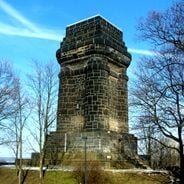
Velká strahovská zahrada, Monastic garden in Hradčany, Prague, Czech Republic
The Great Strahov Garden spreads across multiple levels with paved paths, grass areas, and carefully arranged flower beds around the monastery buildings. The layout combines structured garden sections with open spaces that run through the grounds and connect different areas together.
The garden's land was donated to the Premonstratensian Order by Prince Vladislav II in 1140 for founding the Strahov Monastery. Abbot Jan Lohel had the Romanesque aqueduct rebuilt between 1586 and 1612, channeling springs from Petřín's eastern slopes to irrigate vineyards and the utility garden. After Swedish troops plundered Strahov during the Thirty Years' War, restoration began after 1658 under Abbot Vincenc Makarius Frank, and architect Giovanni Domenico Orsi designed early Baroque buildings including the fruit-drying house, now the gardener's house, in 1671–1679.
The garden belongs to the Premonstratensian monastery founded in 1140 by Prince Vladislav II, who gave the order the land. Abbot Jan Lohel (1586–1612) had the Romanesque water conduit rebuilt and the springs on Petřín's eastern slopes channelled through underground tunnels to irrigate the vineyards and kitchen garden. The gardener's house, No. 133/IV, is a former fruit-drying building designed by Giovanni Domenico Orsi in 1671–1679.
The grounds are best explored on foot, with several access points around the monastery buildings and paths connecting all areas together. Comfortable shoes are advised as the garden spreads across different elevation levels and some walkways have steep inclines.
From higher sections of the garden, views open toward Prague's Old Town and surrounding neighborhoods while remaining in the secluded calm of the monastery grounds. This contrast between the busy city below and the spiritual space above creates a distinctive experience.
The community of curious travelers
AroundUs brings together thousands of curated places, local tips, and hidden gems, enriched daily by 92,122 contributors worldwide.