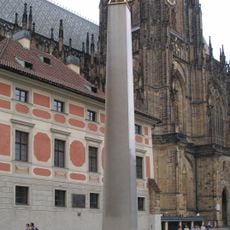
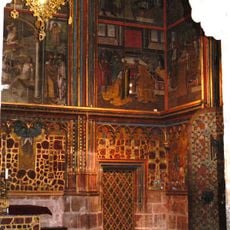
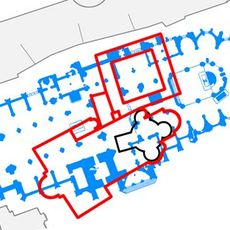
Býčí schodiště, Historic staircase in Hradčany, Prague, Czech Republic.
Býčí schodiště features multiple flights of stone steps designed by Slovenian architect Jože Plečnik between 1927 and 1931, connecting different levels of Prague Castle complex with geometric precision and classical modernist elements.
Constructed during the presidency of Tomáš Masaryk in the interwar period, this staircase represents early 20th-century Czech architectural renewal and Plečnik's innovative urban design philosophy that transformed Prague's historic landscape.
The name comes from the bronze bulls by sculptor Damian Pešan that stand on the entrance columns and carry gilded beams draped with a bronze carpet, a reference to Gottfried Semper's theory of the textile origins of architecture. The bulls evoke Minoan art and possibly the bull of Kerameikos that Plečnik saw in Greece in 1927.
The staircase links the Third Courtyard of Prague Castle with the Na Valech garden; the entrance is framed by four prismatic columns of Lipová marble topped by bronze bulls. The first flight passes through the Romanesque Soběslav wall, then the stair becomes double-armed, with landings projecting as viewing balconies over the garden.
Plečnik deliberately sourced stone from Czech quarries rather than established European ones, helping revive the local stone industry. He used golden Kopanina opuka, until then only a building material, as a wall facing, and black polished diorite from Prachatice for the landing columns.
The community of curious travelers
AroundUs brings together thousands of curated places, local tips, and hidden gems, enriched daily by 92,311 contributors worldwide.