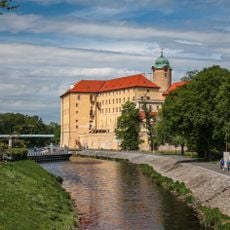
Church of the Assumption of the Virgin Mary in Poděbrady, Early Baroque church in Poděbrady, Czech Republic
The Church of the Assumption of the Virgin Mary, also called the Miners' Church, is a single-nave early Baroque building from 1665–1666 in the Zámostí district. Its facade has a neo-Gothic portal with a relief of the Assumption by Bohuslav Schnirch (1898), and the windows hold stained glass by Adolf Liebscher.
A wooden church was built on the execution site in 1516 for the Prague burgher Ondřej Prachovec; Swedish troops destroyed it in 1634. The present single-nave early Baroque church was built in 1665–1666. Joseph II abolished it in 1784 and sold its furnishings, but it was later restored as a cemetery chapel and remodelled in Neo-Gothic style in the second half of the 19th century.
The church is also called Havířský kostel, the Miners' Church, after the ten Kutná Hora miners' leaders beheaded on this spot in August 1496; a small stone monument to them stands by its south-eastern edge. Since 1964 it has been deconsecrated and belongs to the town, and it now serves mainly for wedding ceremonies.
The church is deconsecrated and opens only on occasional events; it is used for wedding ceremonies. The bell tower with a brick ground floor and shingle roof stands beside it, and the Komenský well, mentioned by Jan Amos Komenský in 1624, is nearby. The long inundation bridge from the early 19th century carries the first-class road toward Prague past the church.
The church stands by the site where 10 of the 13 leaders of the Kutná Hora miners' uprising were beheaded in August 1496; the town executioner refused to carry out the sentence, so the castle executioner did it. A small stone monument to the buried miners stands by the church's south-eastern edge.
The community of curious travelers
AroundUs brings together thousands of curated places, local tips, and hidden gems, enriched daily by 92,345 contributors worldwide.