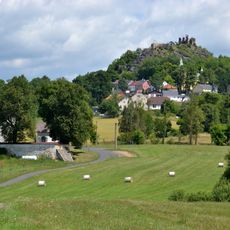
Church of Holy Trinity, Baroque church in Andělská Hora, Czech Republic.
The Church of the Holy Trinity is a single-nave early Baroque church built 1698–1712 to plans by Giovanni Battista Alliprandi. Its ground plan is an equilateral triangle with chamfered corners, three large windows per wall, massive corner pilasters and a three-sided pyramid roof; two of the original three portals were walled up in the mid-20th century.
A wooden chapel dedicated to the Virgin Mary stood here from the Middle Ages, first recorded in 1393; it was likely burned by Hussites under Jakoubek z Vřesovic and rebuilt before 1529 as a Holy Trinity chapel. Count Heřman Jakub Černín had the present church built in 1698–1712 to plans by Giovanni Battista Alliprandi, costing 1242 gulden and taking 14 years for lack of funds. Trinitarian administration ended under Joseph II in 1783, and before 1842 the church became a cemetery church.
The church is now a cultural and social centre with an exhibition space and a ceremonial hall, reopened on 8 July 2006 after reconstruction. Its name recalls the pilgrimage to the healing spring by the old lime tree, where an image of the Holy Trinity once stood.
The church stands on the edge of Andělská Hora, on a road that was once a trade route from Donawitz to Buchau. Two of the three original corner entrances were walled up in the mid-20th century, so visitors enter through the surviving north portal. The interior is now used as an exhibition and ceremony space, and the cemetery around it follows a triangular plan.
The church's ground plan is an equilateral triangle with bevelled corners, and the number three recurs in its three large windows per wall and its three-sided bell turret. Two of the three original corner portals were walled up in the mid-20th century; only the north entrance remains.
The community of curious travelers
AroundUs brings together thousands of curated places, local tips, and hidden gems, enriched daily by 92,144 contributors worldwide.