Gröbeho vila, Renaissance Revival villa in Prague 2, Czech Republic
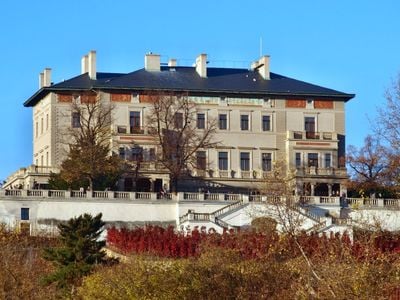
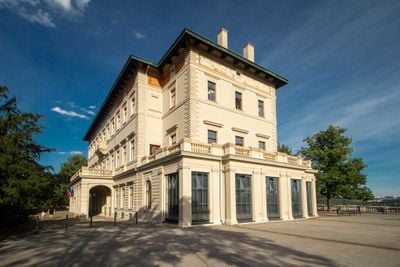
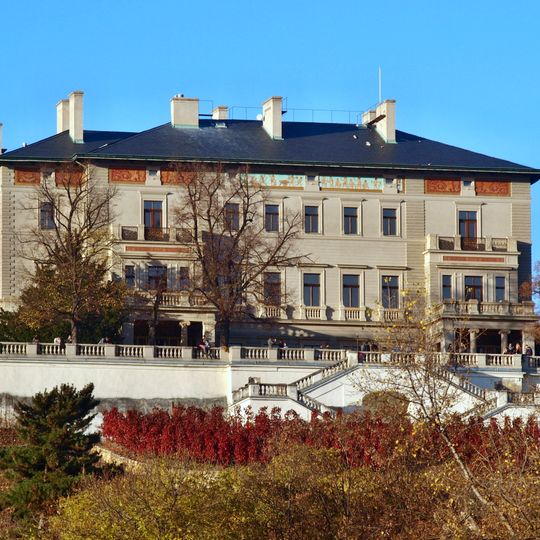
The Gröbeho vila is a Renaissance Revival building in Prague 2 that combines residential space with elegant classical forms. The rectangular house has a prominent columned porch on the northern side and connects to the vineyard below via a two-wing staircase on the south.
The villa was built between 1870 and 1874 as a summer retreat for industrialist Moritz Gröbe during Prague's period of expansion. Architects Antonín Viktor Barvitius and Josef Schulz designed the house to reflect their client's wealth and status in the growing city.
The building's name recalls its original owner, a wealthy industrialist whose taste shaped its design. The interior decoration shows Italian influences through ornamental features like friezes depicting children and classical columns, reflecting the owner's wealth and cultural refinement.
The villa stands on an artificially raised terrace at 241 m above sea level in the centre of Havlíčkovy sady, reachable on foot through the park. A two-arm outdoor staircase leads from the south terrace down into the 1.7-hectare vineyard, from where there are views over Nusle and Vršovice. The grounds around the villa are freely accessible during park opening hours.
The terrace beneath the villa was raised with soil excavated from a nearby railway tunnel whose construction Moritz Gröbe helped finance. The villa's interior holds 30 large rooms linked by a marble staircase under a coffered ceiling designed by Josef Schulz. Since 2001 the building has housed the CEELI Institute.
The community of curious travelers
AroundUs brings together thousands of curated places, local tips, and hidden gems, enriched daily by 92,173 contributors worldwide.