Kamenárka, Natural monument and protected area in Štramberk, Czech Republic.
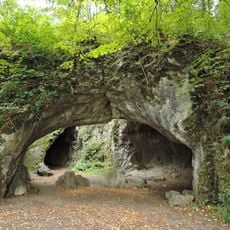
Kamenárka is a disused two-level limestone quarry at the southern foot of Bílá hora (557 m) on the edge of Štramberk, covering 4.46 hectares between 450 and 480 m above sea level. Its walls expose blocks of Tithonian Štramberk limestone, and a small pool called Stříbrné jezírko lies in the middle of the quarry floor.
Limestone was quarried here from the Middle Ages until extraction ended around 1880, leaving a two-level quarry. The site was declared a natural monument in 2001 to protect the Tithonian Štramberk limestone exposure and its protected species. In 1986 Apollo butterflies from Slovakia were reintroduced here after the local subspecies Parnassius apollo strambergensis died out.
The name comes from the Czech word for quarry, kamenolom, referring to the limestone pit worked here from the Middle Ages until about 1880. The two-level quarry face is still used for climbing; the Kozi stěnka wall and the 15-metre Vánův kámen are the best-known formations. Below Vánův kámen, in 1695, some 1,500 peasants from the Hukvaldy estate gathered during an anti-feudal uprising.
The natural monument lies at 450–480 m above sea level and covers 4.46 hectares. The quarry has two levels; the upper level holds the small lake, while the second excavation about 100 m to the southeast has limestone walls used for climbing. The protected area is fenced and has no marked trails, so visitors should keep to its edges and avoid the lake and rock walls.
The wall lizard population here is the only one in the Czech Republic, and the Apollo butterfly was reintroduced from Slovakia in 1986 after the local subspecies Parnassius apollo strambergensis died out by the 1930s. The white stonecrop on the rock walls is the caterpillar's food plant.
The community of curious travelers
AroundUs brings together thousands of curated places, local tips, and hidden gems, enriched daily by 92,344 contributors worldwide.