Památník Vojna, Prison museum and memorial in Příbram, Czech Republic.
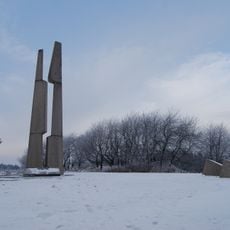
Památník Vojna is a museum exhibition on the site of the former Vojna forced-labour camp, about 5 km southeast of Příbram, where the Lešetice, Lazsko and Zavržice boundaries meet. The grounds hold reconstructed period buildings, a concrete watchtower, and the permanent exhibition "Uran v českých dějinách". It has been a branch of the Hornické muzeum Příbram since opening to the public in 2005.
The camp was built between 1947 and 1949 by German prisoners of war and named after the nearby Vojna hill. From mid-1949 to 1951 it held political prisoners of the emerging communist regime, who worked in nearby uranium mines and on expanding the camp. It served as a prison facility until an amnesty closed it on 1 June 1961; the army used the site until 2000.
The camp takes its name from the nearby Vojna hill, and the same name is borne by the concrete watchtower on the grounds. Since 2005 the site has been a branch of the Mining Museum Příbram, offering three tour routes: the reconstructed camp buildings, a permanent exhibition titled Uranium in Czech History, and the Orbis Pictus Europa gallery of modern European art.
The site lies about 5 km southeast of Příbram, at the meeting point of Lešetice, Lazsko and the Zavržice part of Příbram. Three guided routes cover the camp grounds, the uranium exhibition and the Orbis Pictus gallery, so allow time for all three. The grounds are outdoors and partly uneven.
The grounds served as a center for forced uranium extraction, distinguishing it from other historical sites in Central Europe. This mining aspect is documented in the exhibitions and reveals an often-overlooked dimension of repression from that era.
The community of curious travelers
AroundUs brings together thousands of curated places, local tips, and hidden gems, enriched daily by 94,165 contributors worldwide.