Rotava, Natural monument with columnar basalt formations in Rotava, Czech Republic.
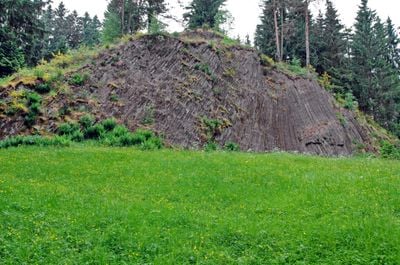
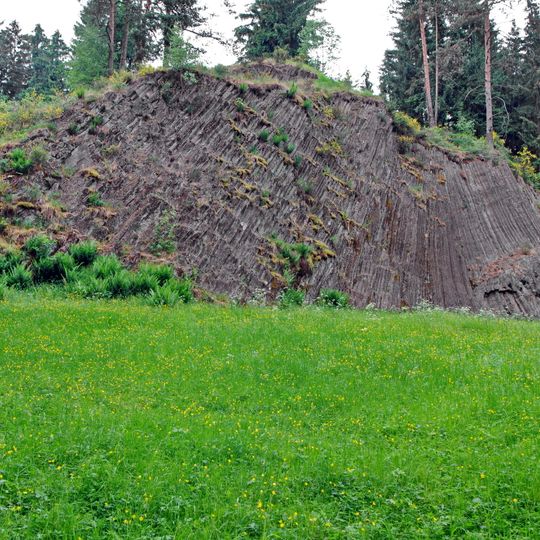
Rotava, known as the Rotava Organ, is a natural monument about 1 km east of the village of Rotava in the Sokolov district. Intensive quarrying exposed a volcanic hill whose basalt columns, arranged like a millstone, reach up to 12 m high. The site lies where the Karlovy Vary granite pluton meets the crystalline mantle of the Krušné hory.
The site was declared a natural monument in 1978. Quarrying in the past exposed the internal structure of the volcanic hill, and many broken basalt columns were used as gravel for roads.
The name "Rotava organs" comes from the columnar basalt, whose vertical prisms resemble organ pipes. The columns reach up to 12 m and were exposed by quarrying; broken columns were once taken away as gravel for roads.
The site is accessible via marked walking trails and can be visited throughout the year. Morning hours offer the best lighting conditions to clearly see the structure and patterns of the basalt columns.
The columns reach up to 12 metres high and were exposed by intensive quarrying; many broken columns were once used as gravel for roads. The rock is limburgite, a glassy basalt formed by rapid cooling of viscous lava.
The community of curious travelers
AroundUs brings together thousands of curated places, local tips, and hidden gems, enriched daily by 92,126 contributors worldwide.