Sitrův dům, Cultural monument in Prachatice I, Czech Republic.
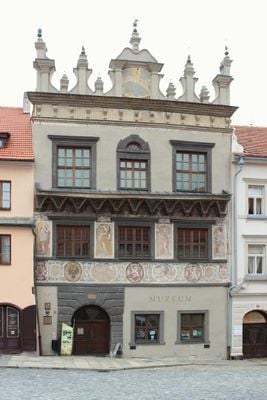
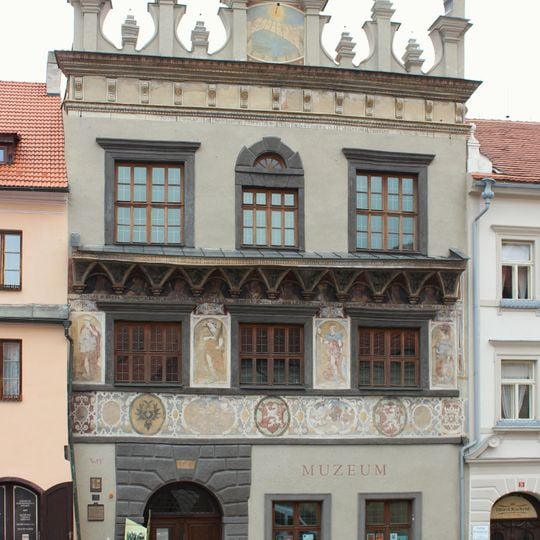
Sitrův dům is a two-storey Renaissance row house on the north side of Velké náměstí, three window axes wide, with a rusticated entrance portal and a semicircular rusticated fanlight over the middle second-floor window. Its facade carries mannerist frescoes, and the steep gabled top is crowned by a small clock tower with scrolled gables and finials.
The house was first documented in 1521, when Barbora Vacková bequeathed her property to her son-in-law Jan. In 1581 Ambrož Sitr from Volary bought it for 930 kopecks of Meissen groschen for his son Tomáš, who had builder Josef Fargit rebuild it in 1604. The city acquired it in 1950 and opened the museum on 5 July 1954.
The museum inside explains Prachatice's boom and the Golden Steig salt route. On the first floor, between the three large windows, four painted allegories survive: Justitia, Patientia, Prudentia and Fortitudo; the lunettes above show ten Bohemian rulers from Wenceslaus IV to Rudolf II.
The museum entrance is the rusticated portal on the left of the ground floor, marked MUZEUM above two windows; the rear wing is reached from Neumannova Street at house no. 183. Cellars and vaulted ground-floor rooms were rebuilt between 2006 and 2007, and the museum reopened after work from 1987 to 1993.
The crossed hammer and set square in a painted cartouche beneath the first-floor windows, with the inscription "Jozef Ffargit Mestenin Sczeskych Budegicz", names the builder of the 1604 reconstruction. The painter Šebestián Hájek signed his work on the right side of the band between ground floor and first floor with "1604 Sebestian Hajek", now partly illegible.
The community of curious travelers
AroundUs brings together thousands of curated places, local tips, and hidden gems, enriched daily by 92,223 contributors worldwide.