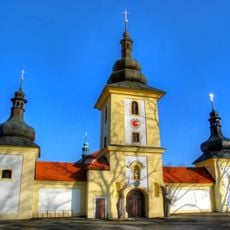
Schloss Starý Hrozňatov, Gothic Revival and Romanesque château in Starý Hrozňatov, Czech Republic.
Schloss Starý Hrozňatov is a castle in Starý Hrozňatov that combines Gothic and Romanesque elements perched on a hillside. The building is dominated by a central bergfried tower that rises above the surrounding structure and connects to an adjacent chapel.
The site began as a Romanesque castle, probably built in the 12th century; Ušalk of Kinsberg is mentioned in 1188, and the first written record dates from 1217, when Heinrich von Künsberg witnessed a contract. An early Gothic rebuild followed in 1233. In 1322 it became a fief of the Bohemian Crown, and after Swedish troops took it in 1647 it was restored in Baroque style. The present neo-Gothic look comes from Adam Haberzettl's design after 1872.
The castle's German name Kinsberg, also written Kinsperk, comes from the medieval Künsberg family, and the Czech name Starý Hrozňatov distinguishes it from the village around it. Since 1965 the grounds have housed damaged Baroque sculptures collected from borderland cemeteries, crossroads and wayside shrines, brought there for restoration by gallery director Bojmír Hutta.
The château stands on a slope at the edge of Hrozňatov, and the road continues past it to the Maria Loreto pilgrimage church. The renovated building is not open to the public, so visits are limited to viewing the exterior.
The oldest surviving part is the Romanesque Black Tower, a round bergfried with walls 2.9 metres thick, entered by a bridge through a first-floor portal. A gate pocket for the bar is preserved in the tower body, and the castle is separated from the rest of the hill by a ditch partly cut into the rock.
The community of curious travelers
AroundUs brings together thousands of curated places, local tips, and hidden gems, enriched daily by 92,314 contributors worldwide.