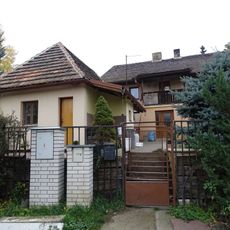
Sklenářka, Historical farmstead in Praha-Troja, Czech Republic.
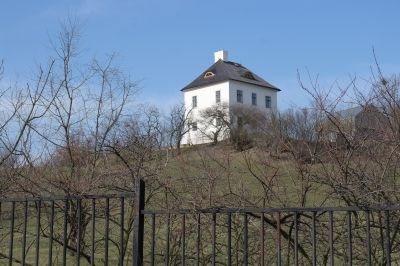
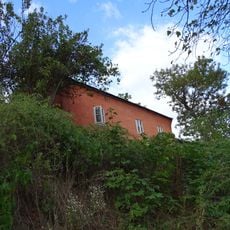
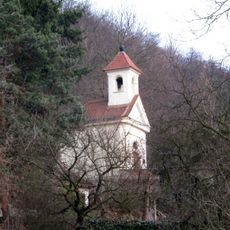
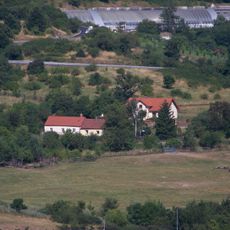
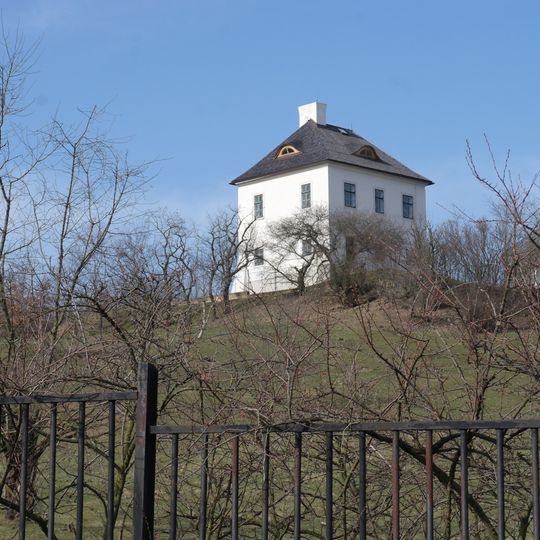
Sklenářka is a farmstead on the summit of a hill in Prague 7-Troja, Pod Hrachovkou street, standing apart from surrounding buildings. It was built on vineyard land as a wine press and later adapted into a dwelling with a ground-floor flat for the caretaker and a summer apartment for the burgher owner upstairs. The rectangular, tower-like structure has a hipped roof pierced by a massive chimney, and its corners are reinforced with slanting buttresses.
Sklenářka stands on former vineyard land and was first built as a wine press. It was later adapted into a homestead with a ground-floor flat for the steward and a summer apartment for the burgher owner upstairs. Its layout and beam paintings date its origin to the last quarter of the 17th century. From the mid-20th century it housed Prague Zoo staff, was lived in until the 1980s, then decayed until renovations in 1988–1990 and 2011–2012.
The homestead appeared in the 1931 film Psohlavci, directed by Svatopluk Innemann. Its nickname Katovna, or Executioner's House, is said to come from this shoot, because a gallows stood by Sklenářka in the film. The building is one of the historic structures on the grounds of Prague Zoo.
Sklenářka stands on a hilltop in Prague 7-Troja, on Pod Hrachovkou street, within the grounds of Prague Zoo and without surrounding buildings. Access is through the zoo, so allow time to walk the grounds and look for the homestead on the hill. The building now serves as representation space for the zoo and is not a separate museum.
The building is also called Katovna, or Executioner's House, likely because a gallows was placed beside Sklenářka during the filming of the 1931 film Psohlavci, directed by Svatopluk Innemann. The nickname thus comes from a film set rather than from any execution held there.
The community of curious travelers
AroundUs brings together thousands of curated places, local tips, and hidden gems, enriched daily by 93,781 contributors worldwide.