Roverské skály, Special Area of Conservation in the Česká Lípa District, Czech Republic
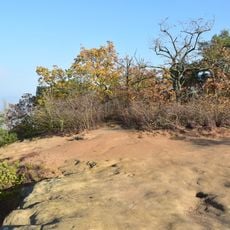
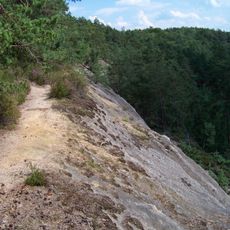
Roverské skály is a sandstone area of 1,688.58 ha in the Polomené hory hills, between Bliževedly and Duba in the Česká Lípa district. Its Cretaceous Jizera Formation sandstones form a stepped relief with a dense network of canyon-like valleys and no permanent streams. Over three quarters of the site is covered by subcontinental pine-oak forest, with relict pine woods on rock edges and summits.
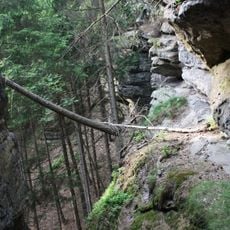
The sandstone of Roverské skály belongs to the Jizera Formation, deposited during the Middle and partly Upper Turonian. Erosion and denudation later shaped it into a stepped relief with a dense network of canyon-like valleys that carry no permanent streams. The area was declared a European Site of Conservation Interest by government regulation No. 208/2012 of 25 April 2012, covering 1688.5811 hectares.
The name Roverské skály likely comes from rover scouts who camped here in the late 1960s and early 1970s. The tramp settlement Roverští patrioti meets here and in 2015 planted a 63-tree avenue of old regional fruit varieties along the Stará Husí cesta between Dřevčice and Martinské stěny; it won the national Alej roku contest in 2017.
The area lies between Bliževedly in the northwest and Duba in the southeast, with access points in the cadastral villages of Domašice, Dřevčice, Heřmánky, Hvězda pod Vlhoštěm, Lhota u Dřevčic, Pavličky, Skalka u Bliževedel, Tuhaň, Tuhanec and Zátyní. The sandstone plateaus and canyon-like valleys carry no permanent streams, so bring your own water. Trails pass the Tisícový kámen (Tisícák) rock and the neighbouring Krápník overhang. Since November 2023 the Kokořínsko – Máchův kraj administration has been clearing illegal tramp camps and cabins, so camp only where permitted.
The main protected feature is Trichomanes speciosum, a fern listed in the IUCN Red List and protected by the Bern Convention. It reproduces only vegetatively and forms colonies in rock hollows, crevices and overhangs that receive no sunlight and stay humid. Its occurrence in the Czech Republic is native.
The community of curious travelers
AroundUs brings together thousands of curated places, local tips, and hidden gems, enriched daily by 92,681 contributors worldwide.