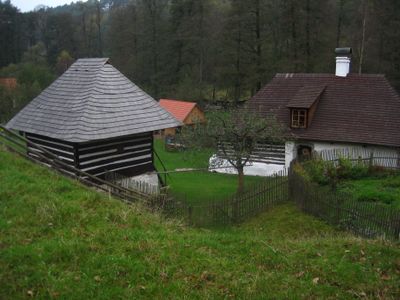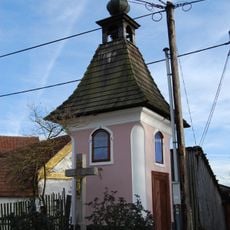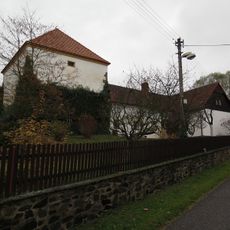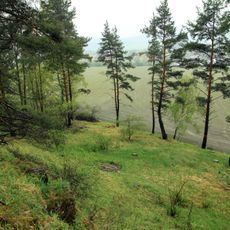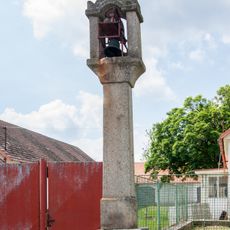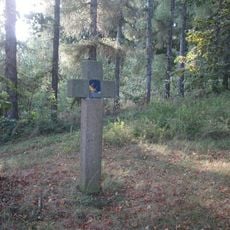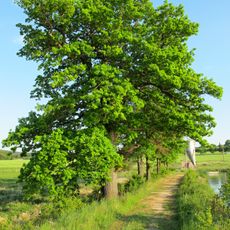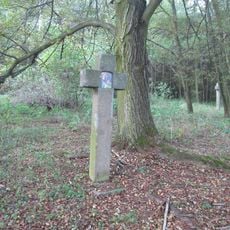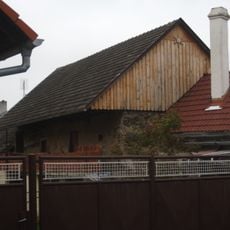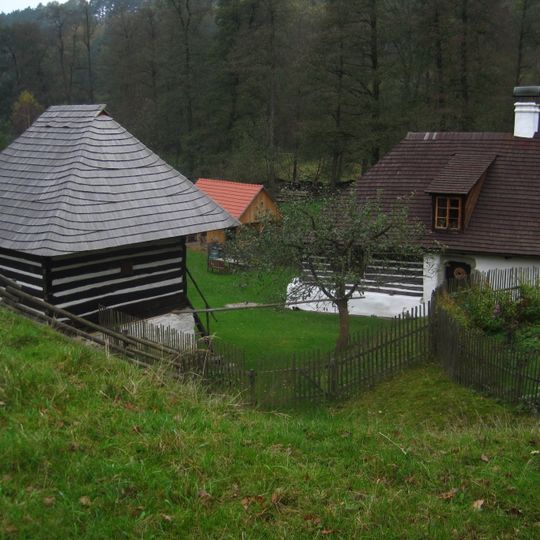
Křížkův mlýn, Watermill in Bláhova Lhota, Czech Republic.
Křížkův mlýn is a timber watermill building with a granary for storage and a black kitchen featuring an open hearth. The complex contains functional spaces showing how the mill operation worked and supported the people living there.
The core of the building dates from the late Middle Ages, and the timbered structures were added in the 18th century. The Gothic stone portal bears the date 1507, which marks the portal, not the mill's founding. A sawmill burned down in 1791, and the last milling took place in 1890. A low stone lean-to on the north side of the mill housed an oil press and a stamp mill.
The mill is named after the Křížek family, its owners, and locals also call it U Křížků or Sosnovcův mlýn. A Jesuit priest, Antonín Koniáš, is said to have burned confiscated "heretical" books in the garden in 1740. Another local legend tells of two witches who kept a human skull in the mill, later found when the miller's brother struck a wall with his stick.
The mill sits in a stream valley and is accessible from the main road via a short marked path. Wear sturdy shoes as the ground around the buildings can be uneven and muddy depending on the season.
The mill's name comes from the Křížek family; it was also called U Křížků or Sosnovcův mlýn after the Sosnovec family, who owned it until the last heiress sold it in the 1970s to cameraman Vladimír Wiesner. From 1993 it belonged to the Macourků family, and screenwriter Miloš Macourek stayed there in 2002.
The community of curious travelers
AroundUs brings together thousands of curated places, local tips, and hidden gems, enriched daily by 92,750 contributors worldwide.