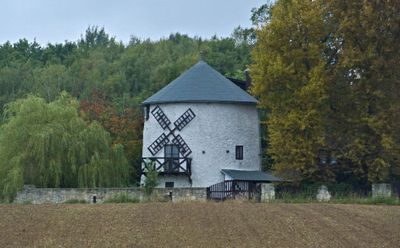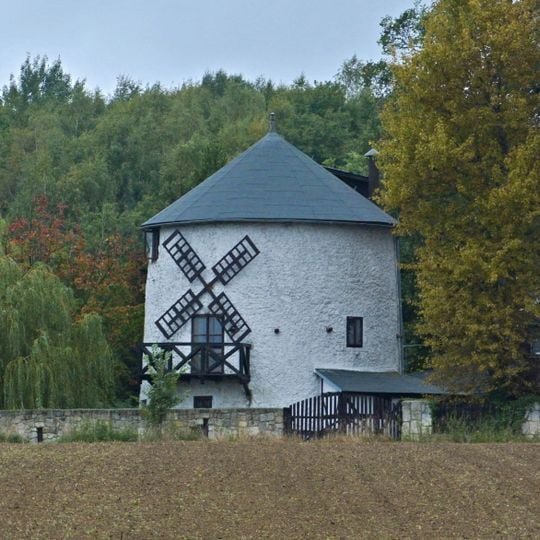
Scholzeho větrný mlýn, Dutch windmill in Václavice, Czech Republic
Scholzeho větrný mlýn is a traditional windmill structure located in Václavice in northwestern Czech Republic. The building served as a grain processing facility and now stands as a protected cultural monument in this region.
Josef Scholze, a carpenter and farm owner from Václavice, built the windmill in 1842–1843 with two grinding sets and a grinder; records mention 14,000–16,000 measures of grain milled yearly. His son Filip ran it and from after 1860 rented it out, as local farmers increasingly took grain to nearby Žitava. Gotthelf Berndt, the last miller (1870–1875), also kept a bakery; after 1875 only grinding continued, and in 1890 operations ceased and the sails were removed.
The mill stands on the so-called Smugglers' Path (Pašerácká stezka) on the road between Uhelná and Václavice, a route whose name recalls cross-border smuggling. Local farmers gradually abandoned it for the mills of nearby Žitava (Zittau), which ended milling here. Its German name was Kohlige, and the site is one of only two surviving windmills in the Liberec region.
The interior is not open to the public; the mill can only be viewed from outside. It stands right of the road from Uhelná to Václavice, on the former Smugglers' Path, about 400 m from each village and under 1 km south of the Czech-Polish border. Access is via road I/35 and then a local road also followed by cycle route 3039, the Hřebenovka. Bus stops exist in both villages, but connections to Hrádek nad Nisou, Chrastava or Liberec are very limited.
After 1875 the mill only ground feed, and milling stopped entirely in 1890, when the sails were taken down. A 1909 record notes the building was then used as a hayloft. The ruin was rediscovered in 1973 by Jiří Fanta, who bought it from the state a year later and restored it.
The community of curious travelers
AroundUs brings together thousands of curated places, local tips, and hidden gems, enriched daily by 92,722 contributors worldwide.