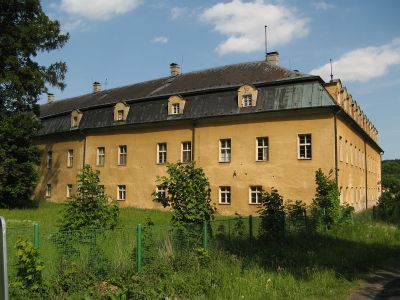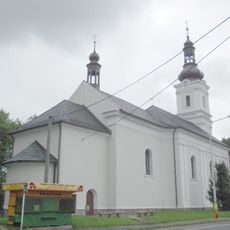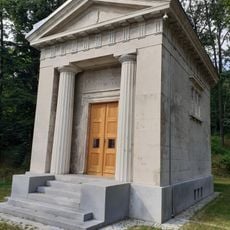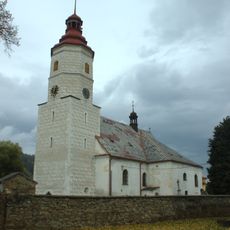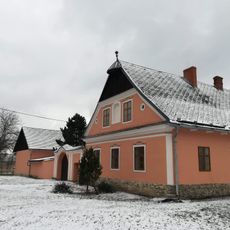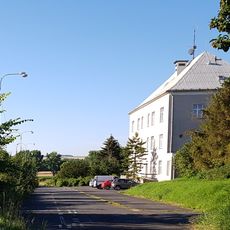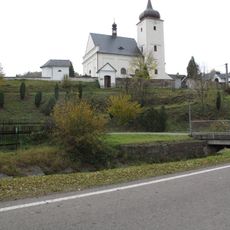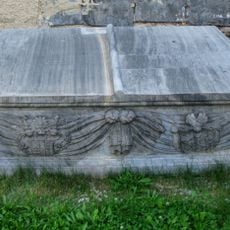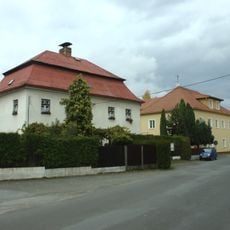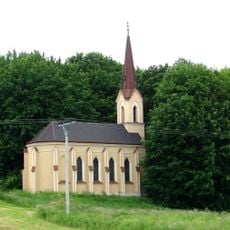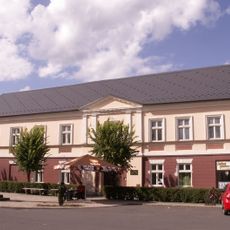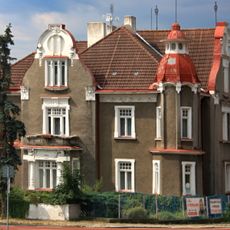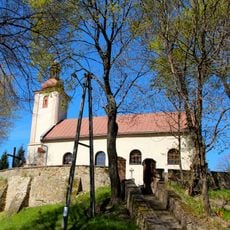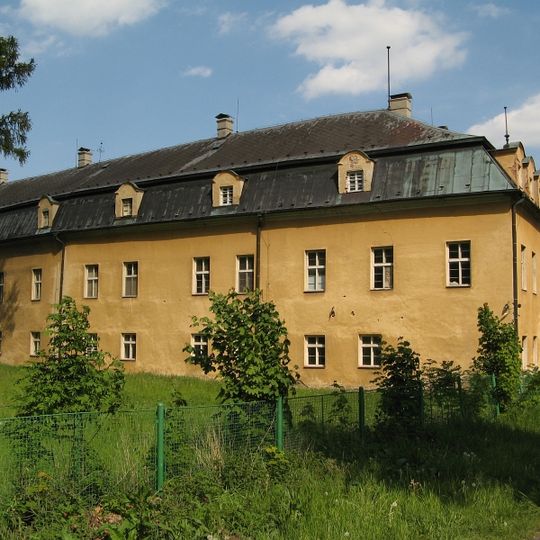
Hošťálkovy Mansion, Renaissance château in Hošťálkovy, Czech Republic.
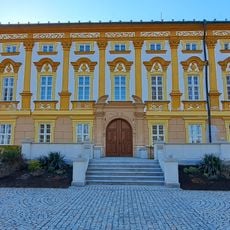
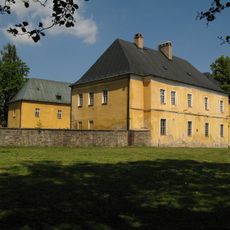
Hošťálkovy Mansion is a three-wing, single-storey building on a U-shaped plan, covered by a mansard roof with two brick prismatic turrets topped by lanterns on its eastern faces. Karl Traugott Skrbenský gave it a unified facade, and in 1831 Heinrich von Arco added a portico to the courtyard front of the west wing. The adjacent grounds include a former estate farmyard and an English park with an orangery.
A fortress at Hošťálkovy is first recorded in 1566. In the second half of the 17th century Jan Kryštof Skrbenský z Hříště (1665–1725) replaced it with a Baroque mansion. His distant Catholic relative Karel Traugott Skrbenský (1716–1790) made Hošťálkovy his main residence, enlarged and richly decorated the château, and kept a musical ensemble there. The Skrbenský family held it until 1831, when it was sold for 140,000 gulden to Count Karl von Strachwitz.
The mansion takes its name from the village and served as a residence for local noble families across centuries. The rooms still reflect the tastes of different periods, from Renaissance choices to later renovations made by successive inhabitants.
The mansion stands in the northeastern corner of Hošťálkovy, about 8 km northwest of Krnov's centre in the Bruntál district. The owner, Spolek Renesance z.s., has opened the building to the public and runs its reconstruction; interiors were first opened in 2015 and a guided tour circuit has been installed since 2019. The building is a cultural monument, protected since 1958.
The chapel of the Holy Trinity, built after 1768, has ceiling frescoes by Jan František Jablonský showing the Assumption of the Virgin with the twelve apostles around an empty tomb. The staircase vaults carry scenes from classical mythology, and the organ case bears the coats of arms of Karel Traugott Skrbenský and his wife Gabriela of Poppen.
The community of curious travelers
AroundUs brings together thousands of curated places, local tips, and hidden gems, enriched daily by 92,603 contributors worldwide.