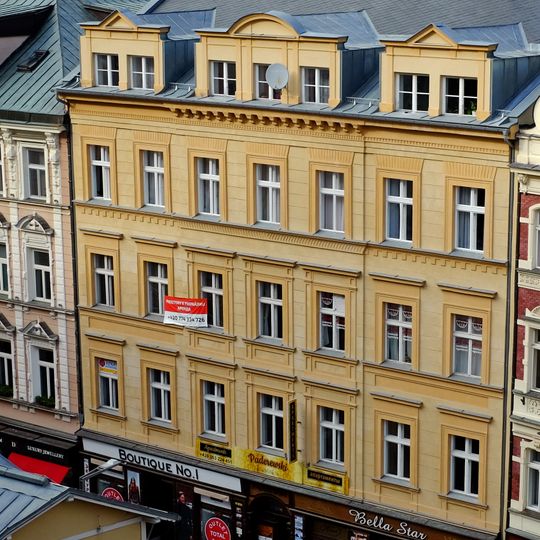
Spa Hotel Paderewski, Cultural monument in Karlovy Vary, Czech Republic.
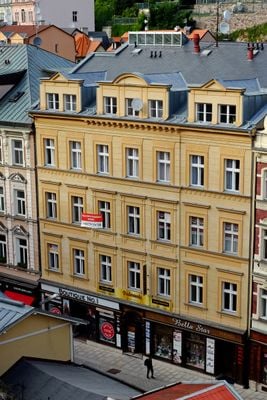
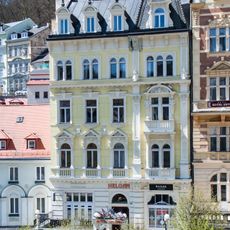
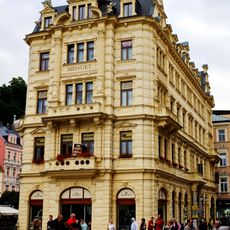
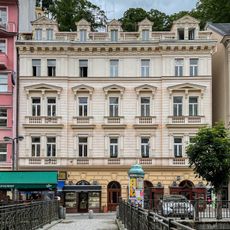
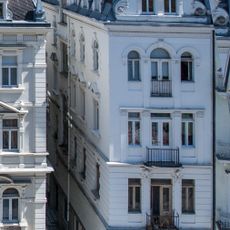
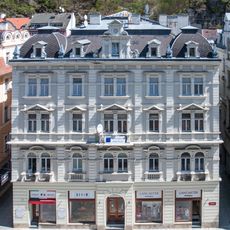
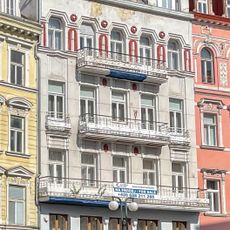
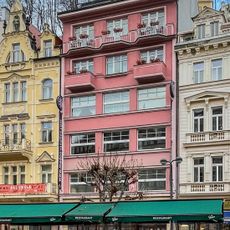
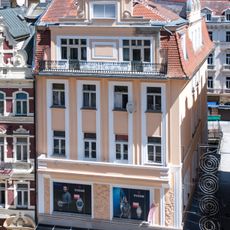
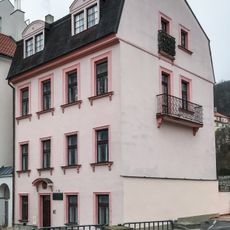
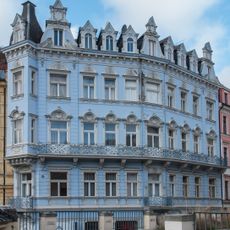
Dům Paderewski, originally Kaiser von Österreich, is a four-storey terraced house at Lázeňská 480/5 in Karlovy Vary, built in 1867–1868 to plans by Johann Voigt. It is a late Neoclassical or Biedermeier building with Romantic Historicist elements: full-surface rustication, an arched frieze and arcature, a dentil course, and simple Italianate window aedicules with chequered parapet panels. The mansard roof storey has three rectangular windows under a segmental tympanum, with triangular tympanums on the end sections.
A Baroque house built by Mrs. Torellin after the town fire of 1759 stood on this site and served as an official building in 1828. In 1867–1868 Josef Stieff replaced it with a new house named Kaiser von Österreich (Emperor of Austria), designed by Karlovy Vary builder Johann Voigt. After 1890 architect Alfred Bayer planned Neo-Baroque facade and roof alterations that were never carried out; dormer windows were added in the early 20th century. The house was listed as a cultural monument in 1973.
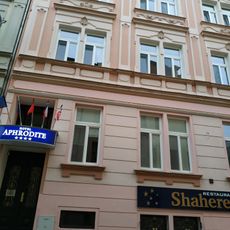
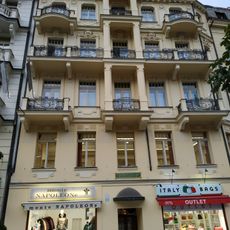
The house bears the name Paderewski, recalling the Polish pianist and statesman Ignacy Jan Paderewski, a regular guest of Karlovy Vary's spa season. Its original name was Kaiser von Österreich, Emperor of Austria, given by builder Josef Stieff in 1867–1868. Look for the lettering and the late-classical façade with full-surface rustication and arched frieze.
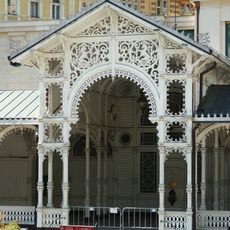
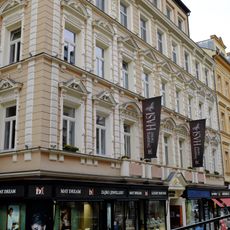
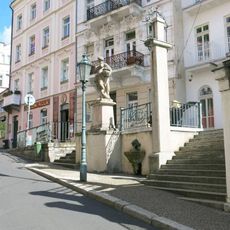
The house stands at Lázeňská 480/5 in the spa centre of Karlovy Vary, within the town heritage zone, a short walk from the colonnades. It is a four-storey terraced building with a mansard roof and three windows in the central mansard section. Look for the full-surface rustication, the arched frieze and the dentil course on the facade.
The house was built in 1867–1868 by Josef Stieff and named Kaiser von Österreich (Emperor of Austria); the name Paderewski came later. Its facade shows full-surface rustication, an arched frieze and sawtooth cornice, and the mansard roof has three rectangular windows under a segmental tympanum, with triangular tympanums on the end sections.
The community of curious travelers
AroundUs brings together thousands of curated places, local tips, and hidden gems, enriched daily by 94,022 contributors worldwide.