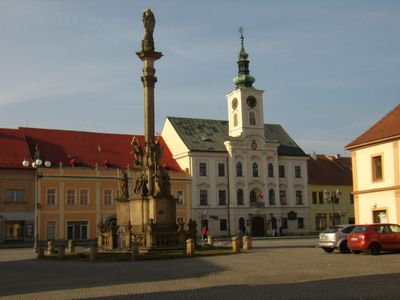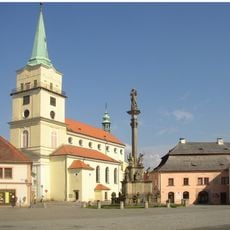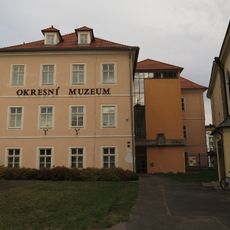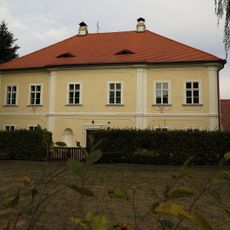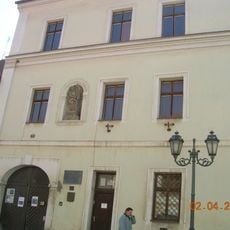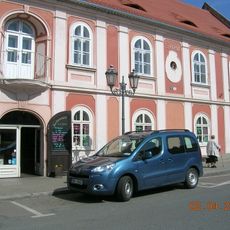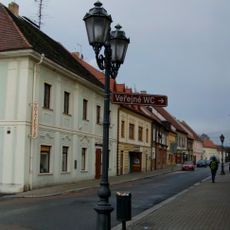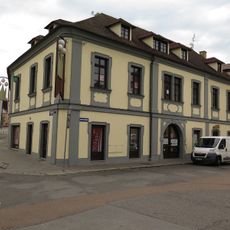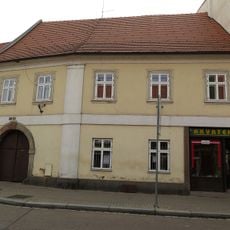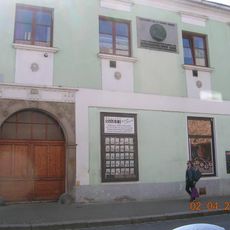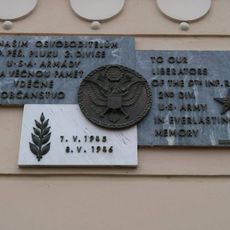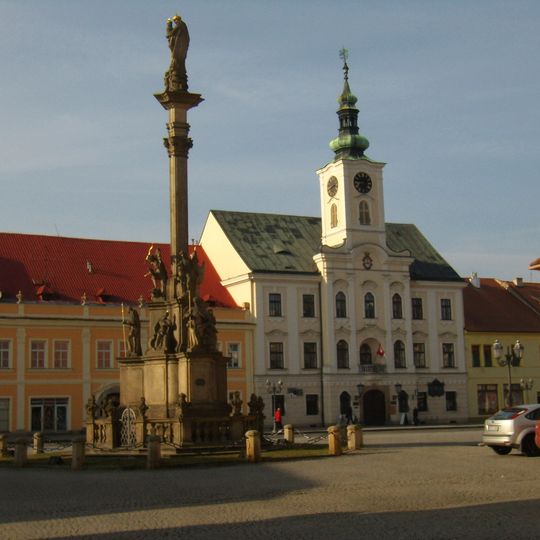
Town hall in Rokycany, Cultural monument and town hall at Masarykovo Square, Rokycany, Czech Republic.
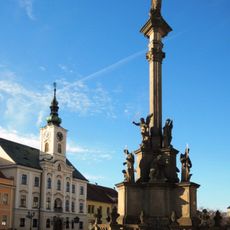
The Rokycany town hall is a Neoclassical building on the southwest side of Masarykovo Square, completed in 1808. Its two-storey facade has a central three-axis projection with an arched portal, a shell-shaped niche holding a balustraded balcony, and a gable with the town coat of arms. A four-sided tower with an onion dome and lantern rises above the centre.
A town hall existed here by 1530, when repairs to its cellar were recorded, on the site of a medieval Gothic house. Swedish troops burned Rokycany in 1639, and a fire damaged the rebuilt early Baroque hall in 1680; it was restored in 1712. Construction of a classicising Rococo replacement began in 1784 under Plzeň builder Antonín Barth, but that year's fire left it a one-storey shell until 1804. Ignác Alois Palliardi then added a storey and the tower, completing the building in 1808.
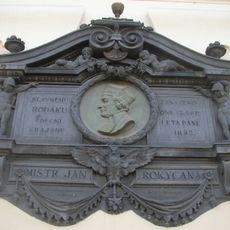
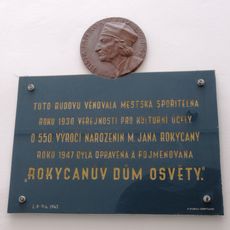
The building serves as the seat of the municipal office. A memorial plaque of Jan Rokycana, the Hussite theologian and archbishop of the Calixtine church, was unveiled on the facade on 13 August 1882. In the 16-meter-long ceremonial hall on the first floor hangs Alfons Mucha's painting "The Basel Council Bows to Jan Rokycana", created in 1933.
The town hall sits centrally on Masarykovo Square and is easily reached on foot from most parts of town. Visitors can view the building and its architecture from the square at any time of day.
The town hall was seized by Russian troops during the 1968 invasion; they tried several times to take over the space for their own offices but never succeeded. In the first-floor ceremonial hall hangs Alfons Mucha's 1933 painting "The Council of Basel Bows to Jan Rokycana".
The community of curious travelers
AroundUs brings together thousands of curated places, local tips, and hidden gems, enriched daily by 94,474 contributors worldwide.