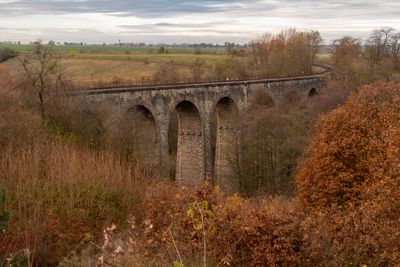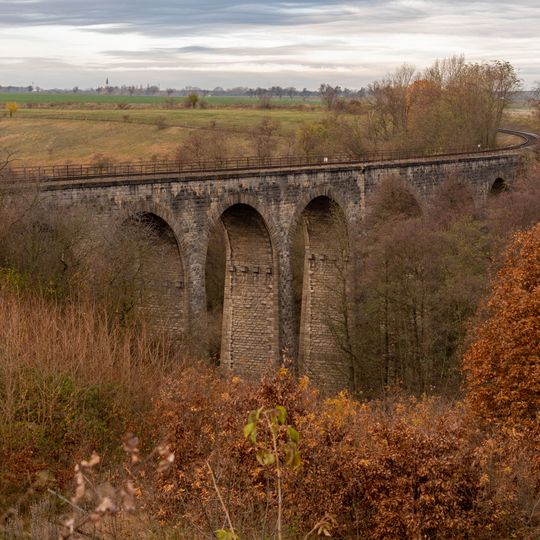
Railway viaduct between Červené Pečky and Ratboř, Railway viaduct between Červené Pečky and Ratboř, Czech Republic.
The railway viaduct between Červené Pečky and Ratboř is a 109-metre-long stone bridge with seven semicircular arches, each spanning 12 metres, rising 31 metres above the Polepka valley. Its arches are built of bossed blocks of Kutná Hora sandstone and granite from quarries near Lipnice nad Sázavou, and the bridge follows an S-shaped ground plan. A plaque on the southwest side bears the year 1900.
The viaduct was completed in 1900 and represented an important step in developing the Czech railway network. This sandstone and granite structure was a technical achievement that opened up the region to rail transportation.
This structure holds official status as a cultural monument of the Czech Republic, marking the engineering achievements of its era. It represents how railway infrastructure shaped the region and connected communities.
The viaduct is visible from the surrounding landscape and can be viewed from nearby paths near Bohouňovice I. Since it carries active train traffic, visitors should observe it from safe distances and avoid the railway zone.
The bridge's ground plan curves in an S-shape, so the seven arches never line up in a single view. Its gravel bed was drained through openings at the tops of the arches, and the arches were insulated with cement screed and asphalt-soaked felt, techniques that were progressive at the time. The original iron railing survives on the bridge.
The community of curious travelers
AroundUs brings together thousands of curated places, local tips, and hidden gems, enriched daily by 94,498 contributors worldwide.