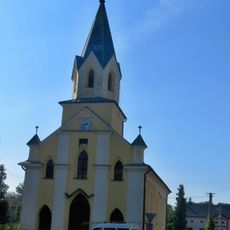
Church of Saint Wenceslaus in Hulín, Romanesque church in Hulín, Czech Republic
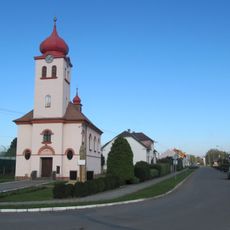
The Church of Saint Wenceslaus in Hulín is a single-nave church with a late Romanesque nave built of rough-grained sandstone blocks, about 15 m long with walls 150–160 cm thick. Its western part is left unplastered, contrasting with the smoothly plastered Baroque addition. A Romanesque stepped portal with a semicircular arch, 520 cm wide and 445 cm high, is sheltered by the northern vestibule called Žebračka.
The church is first documented in 1261, when Hulín passed to the Olomouc bishopric; analysis of its masonry dates the building to the 1230s. A fire in 1747 destroyed the roof, wooden parts and organ, and the repairs of 1749–1754 removed the Romanesque apse, lengthened the nave and vaulted the interior, probably to a design by Bishop's architect Ignác Josef Cyrani of Bolleshaus. In 1780 a passage was cut through the tower and the Romanesque empora replaced by a gallery; Archbishop Antonín Theodor of Colloredo-Waldsee consecrated the church and its five altars on 27 August 1780.
The church is named after Saint Wenceslaus, to whom the high altar was consecrated in 1780 by Archbishop Antonín Theodor of Colloredo-Waldsee, who also blessed four side altars: the Virgin Mary, the Death of Saint Joseph, the Holy Cross and Saint John Nepomucene. A wooden Madonna on a crescent moon, dating from around 1600, once stood in a niche beside the tower staircase.
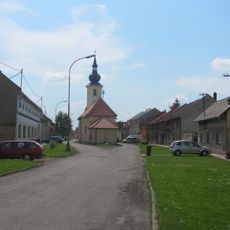
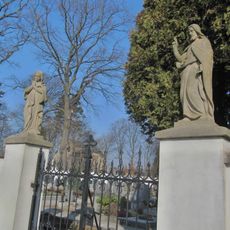
The church stands on a hill in the middle of Hulín, on the site of a vanished fortress near the Rusava stream. The grounds are enclosed by a wall whose irregular plan reveals several building phases; the youngest western stretch has a late Neoclassical gate leading to the main entrance. The former cemetery inside the wall was abolished in 1785.
The church stands on the site of a vanished fortress near the Rusava stream. Its Romanesque nave, about 15 m long with walls 150–160 cm thick, was left unplastered after the 1940s repairs, so the rough sandstone blocks contrast with the smooth Baroque section. A small four-lobed window in the south wall and a round window in the north wall are original Romanesque openings.
The community of curious travelers
AroundUs brings together thousands of curated places, local tips, and hidden gems, enriched daily by 92,777 contributors worldwide.