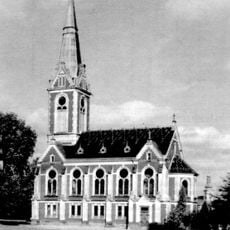
Dittrichova hrobka, Neo-Renaissance tomb in Krásná Lípa, Czech Republic
The Dittrichova hrobka is a Neo-Renaissance mausoleum built in 1888–1889 at the southern end of the cemetery in Krásná Lípa. It has a Greek cross plan with a semicircular apse on the south side, brick walls clad in sandstone, and a roof formed by two intersecting gables. The interior was designed by painter August Frind.
This family tomb was designed by architect Julius Carl Raschdorff between 1888 and 1889 for textile manufacturer Carl August Dittrich and his descendants. The structure reflects the wealth and status of its patron during the late 19th century.
The ten frescoes inside, painted after designs by August Frind, are titled Der Gang durchs Leben (The Journey Through Life) and trace stages from childhood and school to engagement, marriage, charity and death. The glazed-tile stair behind the altar leads down to a crypt whose vaults carry gold and blue mosaics with angels; four death angels fill the spandrels.
The crypt is reached by a left-turning stone staircase behind the altar mensa, with glazed-tile walls; it is not a spiral stair. The building stands at the southern end of the cemetery, outside its main axis, with the town park to the south and west. The roof is damaged and the interior is unrestored, so the crypt is not open to regular visits.
The crypt mosaics were installed around 1895, after the mausoleum was electrified in 1894. About 200 square metres of mosaic cover the vault, 80 percent of it golden tesserae; the Berlin firm Puhl & Wagner, specialising in mosaics, took part in the 1918–1920 restoration by Lossow & Kühne of Dresden. Four death angels appear in the spandrels.
The community of curious travelers
AroundUs brings together thousands of curated places, local tips, and hidden gems, enriched daily by 94,499 contributors worldwide.