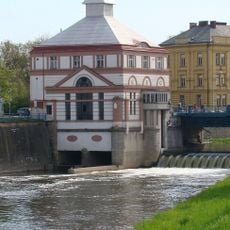
Barokní městské opevnění, Baroque fortification in Hradec Králové, Czech Republic
Barokní městské opevnění is a military fortification from the 1700s with an eight-pointed star layout and walls reaching approximately 10 meters high. The fortress includes multiple entrances and several defensive structures that served different functions within the protective system.
After the Silesian Wars cost Austria Kladsko and Silesia, Hradec Králové was rebuilt as a fortress city in the second half of the 18th century. The design followed Vauban's principles as developed by the Mézières school, drawn up by engineer lieutenant colonel Václav Pavlovský of Rosenfeld and general Jakob R. Spallart. Construction ran from 1766 to 1789, with brick facing of the earthworks added after 1779. Two suburbs and the Rožberk hill were sacrificed for it.
The name reflects the building style that defines this fortification, showing how the city sought military protection in the 1700s. Visitors can observe how this architectural approach shaped the entire complex and its role in the urban landscape.
Of the fortress, only two advanced lunettes survive: Pivovarská flošna, a square casemate building from 1774 long used by a brewery, and Pajkrova flošna near the Faculty of Pharmacy garden, whose north wall has three vehicle openings. Near the Orlice embankment stands the sandstone cone known as Panenka, about 3 m high, from 1784.
The complex included a sophisticated water system that could deliberately flood surrounding areas as an extra defensive layer. This innovative method made approaching the fortress significantly more difficult for any potential threat.
The community of curious travelers
AroundUs brings together thousands of curated places, local tips, and hidden gems, enriched daily by 93,874 contributors worldwide.