Schloss Giessdorf, Château ruin in Jištěrpy, Czech Republic
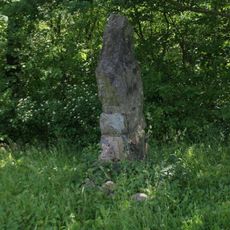
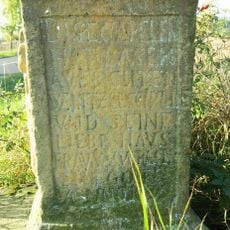
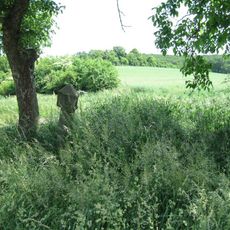
The ruin of Jištěrpy château in Chotiněves, Litoměřice District, is the torso of a Renaissance château rebuilt from an older fortress and demolished after 1806. What survives is part of the footing with reinforced corners, remnants of the wine cellars beneath the building, and several stone elements reused in the walls of village houses. It has been protected as a cultural monument of the Czech Republic since 1964.
Jištěrpy was first recorded in 1318 as a fortress held by Výš. Albrecht of Blatno began converting the old fortress into a Renaissance château around 1589, and work finished after 1605 under Jiří Vilém of Ústí. After the Battle of White Mountain the estate passed to the Jesuits, who had it rebuilt in Baroque style around 1724, probably with Kilián Ignác Dientzenhofer. After 1806 the decaying building was dismantled for construction material.
The name Jištěrpy is first recorded in 1057, while the fortress itself appears in 1318 as the seat of a local noble, Výš. In 1680 a death sentence was pronounced in the courtyard against leaders of a peasant uprising, a moment tied to the site's Jesuit era.
The ruin stands in the village of Jištěrpy, part of Chotiněves in the Litoměřice district. Only a section of the foundation with reinforced corners, remnants of wine cellars and a few carved stone elements reused in village walls survive. The site has been protected as a cultural monument since 1964.
The cellars beneath the former château were wine cellars, and parts of them survive today. The remains also include a section of the footing with reinforced corners and carved stone elements reused in the walls of village houses.
The community of curious travelers
AroundUs brings together thousands of curated places, local tips, and hidden gems, enriched daily by 93,578 contributors worldwide.