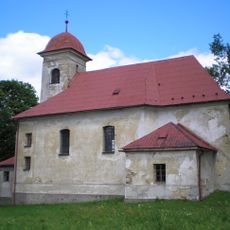
Lovecký zámeček Nové Valteřice, Hunting lodge in Nové Valteřice, Czech Republic.
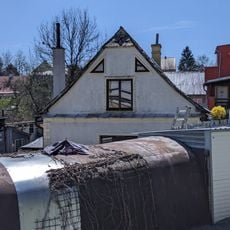
Lovecký zámeček Nové Valteřice consists of two single-storey buildings joined by a covered walkway, both with walls and roofs of corrugated sheet metal. The large main pavilion stands on a massive stone base containing rooms; its front has arcades on cast-iron columns ornamented with lace-like patterns, and barrel vaults are visible inside. The smaller rectangular pavilion behind it, once a dining room, has a gabled roof on flat metal pillars.
The Liechtenstein family built the hunting lodge between 1864 and 1876 on a slope above Nové Valteřice. Its cast-iron pavilion was bought at the Vienna World's Fair of 1873, not in Paris. Confiscated under the Beneš decrees after 1945, it later served as a recreation centre and children's pioneer camp.
The small pavilion, originally a dining room, later served as a camp canteen for children at the summer pioneer camp run by the Hrušov chemical works. The site's heritage protection was declared on 3 May 1958 under register number 30924/8-146. The iron pavilion bought at the 1873 Vienna World's Fair makes the complex a structurally rare example of imported foreign architecture.
The site is privately owned and not open to the public, so there are no guided tours; the buildings can only be viewed from outside. The access path is overgrown and the original staircase is barely visible, traceable only by its surviving railing. The grounds are overrun by self-seeded beeches and birches from the nearby forest.
The structure represents a rare repurposing of an exhibition-tested industrial component that was relocated and reassembled as a private hunting retreat. This unconventional adaptation of a world fair installation into a permanent dwelling demonstrates 19th-century reuse of prefabricated materials.
The community of curious travelers
AroundUs brings together thousands of curated places, local tips, and hidden gems, enriched daily by 92,599 contributors worldwide.