Lipová cesta 17, Cultural monument and villa in Kraslice, Czech Republic
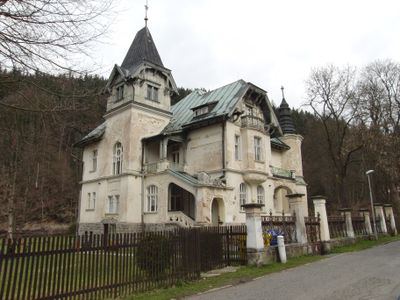
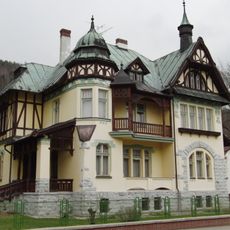
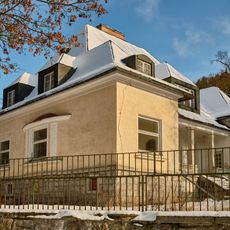
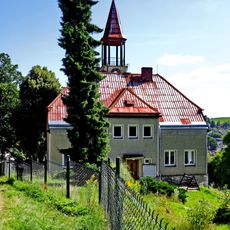
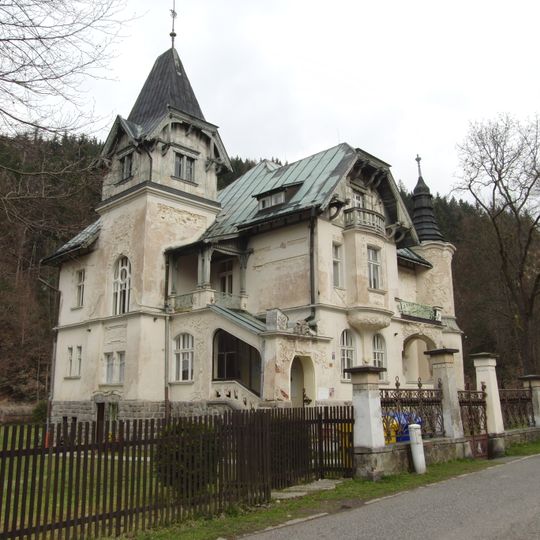
Breinlova vila is a detached romanticising Art Nouveau villa built in 1903 in the English cottage manner, designed by Teplice architect Otto Steinl. Two square blocks meet at a corner, with a massive four-sided tower capped by a tall hipped roof. A central risalit carries a bay window on a conical corbel, crowned by a balcony with wooden railing; a chestnut stucco motif on the corbel recurs in Steinl's work. The southeast corner has a cylindrical bay with stucco angels playing musical instruments, and the ground floor rests on a rusticated stone base.
Anton Richard Breinl, a Kraslice manufacturer of musical instruments and children's toys, had the villa built for himself and his wife Anna in 1903; the date appears on the facade. The Teplice architect Otto Steinl designed it. After Breinl died in 1928 the villa passed to Anna, and from 1934 it changed owners several times. In 1950 the town of Kraslice acquired it, and since 1963 it has housed the two-class kindergarten MŠ Zámeček; it was protected as a cultural monument in 2012.
The villa's decoration ties the house to Kraslice's instrument-making trade: stucco reliefs on the southeast corner show angels playing musical instruments, and a chestnut motif on the corbel is typical of architect Otto Steinl's work. Since 1963 it has housed the two-class kindergarten MŠ Zámeček, named for its castle-like tower and steep roof.
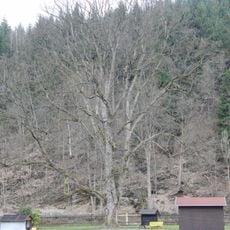
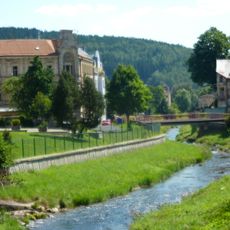
The villa stands on Lipová cesta on the left bank of the Stříbrný potok, in the villa quarter of Kraslice. It is a working two-class kindergarten (MŠ Zámeček, capacity 56 children), so the interior is not open to the public during school hours; the facade, tower, balconies and the wrought-iron fence can be seen from the street. The garden holds the memorial tree Klen u secesní vily in its northern part.
The villa's southeast corner has a cylindrical bay window decorated with stucco reliefs of angels playing musical instruments, a nod to Kraslice's instrument-making industry and to Breinl's own factory. The chestnut motif on the corbel is typical of architect Otto Steinl's work.
The community of curious travelers
AroundUs brings together thousands of curated places, local tips, and hidden gems, enriched daily by 92,665 contributors worldwide.