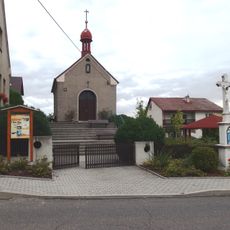
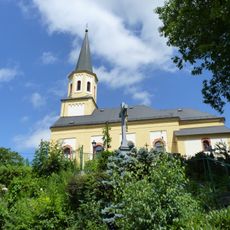
Holy Trinity Chapel, Religious chapel in Markvartovice, Czech Republic.
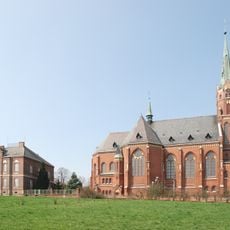
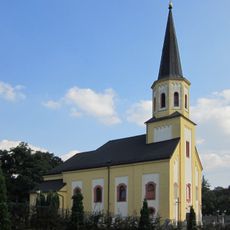
Holy Trinity Chapel in Markvartovice is a single-nave plastered masonry building with a polygonal presbytery, a sacristy added on the south side and a prismatic tower partly set into the facade, topped by a pyramidal sheet-metal roof. The facade is divided by liséne frames and a main cornice running across the tower, whose gable wings end in vases; the nave has rectangular windows with arched tops in surrounds with keystones. The saddle roof is covered with bobrovky tiles.
The early Baroque chapel was built in the mid-17th century; during the 1886 rebuilding a stone block bearing the year 1652 was found, suggesting Alžběta Polyxena, Countess of Vrbno, may have commissioned it. In 1886 the wooden tower was replaced by a masonry one and the nave enlarged. In April 1945 it was hit and burned out, destroying the original altar with the Vrbno coat of arms and wooden statues of St Wenceslas and St Urban; it was repaired and reconsecrated in 1947 and listed as a cultural monument in 1964.
The chapel serves the local community as a gathering place for religious ceremonies and celebrations throughout the year. It remains an important focal point for shared worship in the village.
The chapel is located in Markvartovice within the Opava District of the Moravian-Silesian region and can be accessed through the village's main roads. Visitors can find it easily by following the central pathways of the settlement.
The original bell, cast in 1653 by Opava bell-founder Hans Knauff, weighed about 30–35 kg and bore the inscription "Hans Knauff Trppau goss mich 1653"; it cracked and was requisitioned at the start of World War II. In July 1989 two cast-iron bells from the Ludgeřovice church were hung in the tower.
The community of curious travelers
AroundUs brings together thousands of curated places, local tips, and hidden gems, enriched daily by 92,680 contributors worldwide.