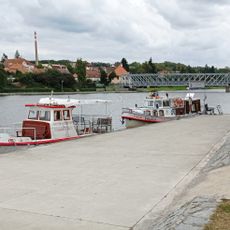
Salt House, Salt warehouse in Týn nad Vltavou, Czech Republic.
The Salt House is a rectangular stone building with thick walls on Solní Street, once designed for salt storage. Its robust construction with heavy masonry reflects the demands this important trade commodity required.
The Baroque salt house was built in 1708 on the left bank in Malá Strana by Antonio de Alfieri, replacing an earlier Renaissance warehouse from 1593 in Podskalí that no longer sufficed. It stored salt shipped from Gmunden via České Budějovice and the Vltava, and served its purpose until 1830, when the state gave up its salt monopoly. In 1831 the Budějovice entrepreneur Vojtěch Lanna bought it and set up shipyards.
The name Solní Street, running along the building, preserves the memory of the salt trade after the older warehouse in Podskalí was demolished. Above the side entrances, restored in 1979 by painter Karel Mezera, frescoes show a crowned double-tailed lion resting on a salt barrel.
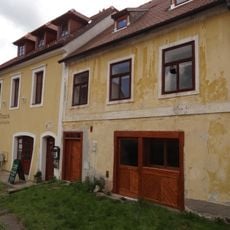
The Salt House stands on the left bank of the Vltava in Malá Strana, on Solní Street, which runs along its length. The entrance is in the middle of the long river-facing side; two further doorways are walled up. The building is in poor condition and not open to visitors, so it is seen from the street.
The 1708 salt house is not medieval: it was built by Antonio de Alfieri, possibly his son, after the older Renaissance warehouse in Podskalí could no longer hold the salt shipped down the Vltava. Look above the central river-side entrance for a faded fresco of a mermaid with a ship, later given a Czechoslovak flag.
The community of curious travelers
AroundUs brings together thousands of curated places, local tips, and hidden gems, enriched daily by 92,607 contributors worldwide.