Les Království Dam, Technical monument in Dvůr Králové nad Labem, Czech Republic.
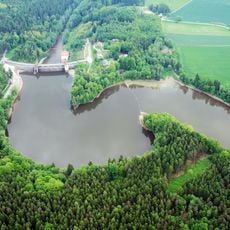
Les Království Dam is a 218 m long and 41.1 m high gravity dam on the Elbe, built of Hořice sandstone in neo-Gothic style. Its structures include two gate towers with turrets above the water intakes, a keeper's house with a bergfried-like tower on the right bank, a smaller tower on the left bank, and a generator house at the dam's foot. The dam wall carries a local road.
Plans for flood protection followed the Elbe flood of July 1897, when 550 m³ per second surged through the narrow valley. Engineer Josef Plicka began designing the dam in 1903; construction started in 1910 and was interrupted by World War I in 1914. Work resumed in 1919 under the new Czechoslovak state and was finished in 1920, making it then the country's largest dam. The power plant, begun in 1920, fed the grid from 1923 with 2 × 600 kW.
The dam's name, Les Království, means "Kingdom Forest", after the wooded Elbe valley between Nemojov and Bílá Třemešná where it stands. The reservoir drowned the Těšnov wood-pulp mill, which belonged to the Elbemühl paper and publishing company. The dam keeper's house on the right bank is built as a tower with battlements, and the road over the crest links Bílá Třemešná with Podháj.
The site is accessible to visitors who want to view the structure and its architectural details up close. The best vantage points are from the riverbanks, where the full extent of the construction becomes clear.
The structure unusually blends industrial function with pseudo-gothic design elements rarely seen in technical constructions of its era. This stylistic choice reflects early engineering aspirations to make functional infrastructure visually appealing.
The community of curious travelers
AroundUs brings together thousands of curated places, local tips, and hidden gems, enriched daily by 92,772 contributors worldwide.