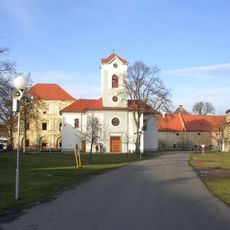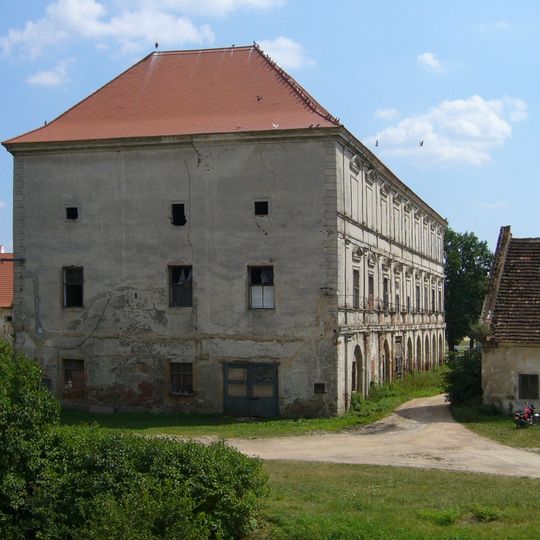
Kestřany Castle, Baroque castle in Kestřany, Czech Republic.
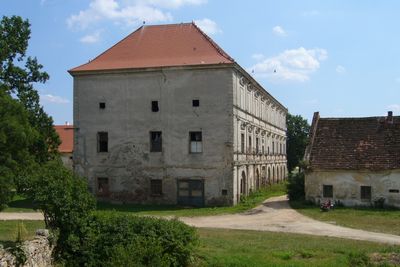
Kestřany Castle is an early Baroque château built after 1651 for Count Karel Paar and his wife Františka Polyxena of Švamberk, next to the older Kestřany fortresses. Its core is a rectangular two-storey building with two short side wings; the main façade is articulated by tall pilasters and a cornice. The ground floor formerly held a sala terrena with stucco decoration and a barrel vault with lunettes, a vault type repeated in other ground-floor rooms.
The Kestřany estate belonged to the Švamberk family until Jan Vilém ze Švamberka died in 1651 and left it to his three daughters. On 12 October 1652 Kestřany passed to Františka Polyxena, wife of Count Karel Paar, and the couple had an early Baroque castle built near the old fortress at a cost of 55,000 guilders. In 1700 Prince Ferdinand Vilém Eusebius of Schwarzenberg bought the estate for 167,500 guilders and attached it to Protivín; the Schwarzenbergs held it until the 1924 land reform.
The castle's name comes from the village of Kestřany, where a manor belonged to the lords of Švamberk until the mid-16th century. The last of that line, Jan Vilém ze Švamberka, died on 6 June 1651 and left the estate to his three daughters; Kestřany fell to Františka Polyxena, wife of Count Karel Paar. The Paars found the old fortress unsuitable and had the early Baroque château built beside it, at a cost said to reach 55,000 gold coins.
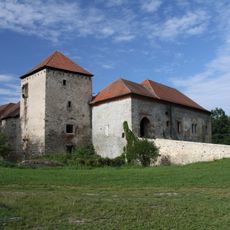
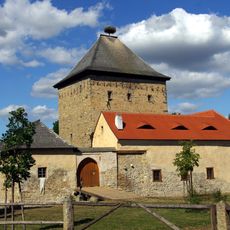
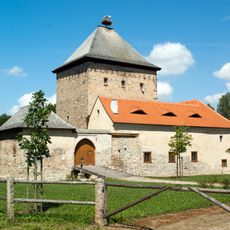
The castle stands next to the village's two medieval fortresses, the lower and upper tvrz, and the whole group is a protected cultural monument. The grounds served as flats, grain stores and workshops in the second half of the 20th century, so expect a working-farm setting rather than a furnished interior. The large economic yard laid out by Pavel Ignác Bayer in 1720 adjoins the building.
The early Baroque château was built after 1652 for Count Karel Paar and Františka Polyxena of Švamberk, who found the old fortress unsuitable; the construction reportedly cost 55,000 gold coins. An ornamental garden and a vineyard were laid out at the same time. In the second half of the 20th century the grounds held flats, grain stores and workshops.
The community of curious travelers
AroundUs brings together thousands of curated places, local tips, and hidden gems, enriched daily by 94,361 contributors worldwide.