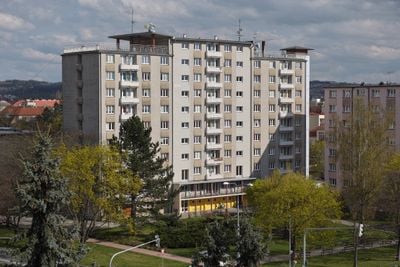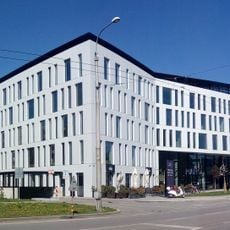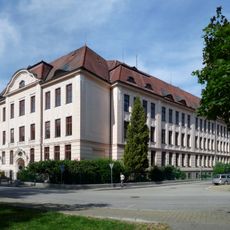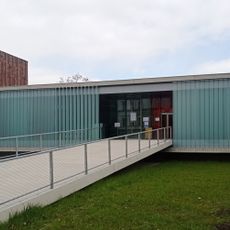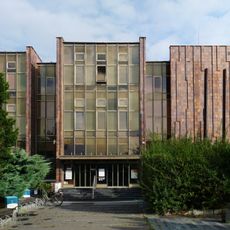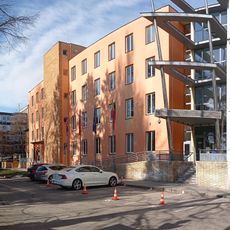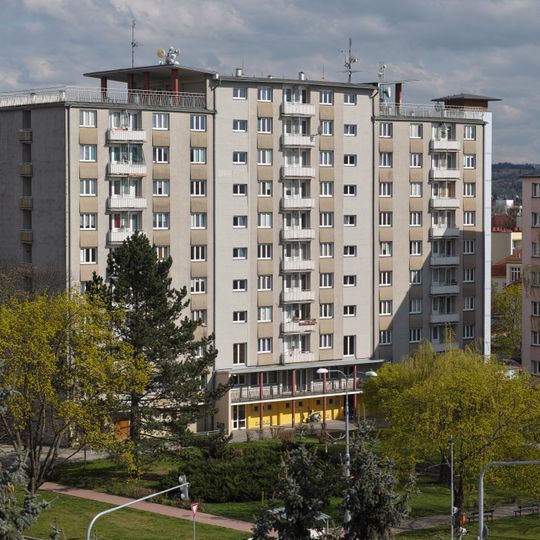
Experiment, Prefabricated tower in Linecké předměstí, České Budějovice, Czech Republic.
Experiment is the ten-storey building at the corner of Lidická and Mánesova, the first panel house in České Budějovice, built 1959–1961. Its reinforced-concrete skeleton was cast without beams and then filled in, since prefabricated panels and bathroom cores did not yet exist. It is a corridor house of hotel type, with small one- and two-bed flats along a single central hallway, and it has unique prefabricated spiral staircases.
The building was completed in 1961 when the Communist government launched large-scale housing programs to address rapid urban population growth. The prefabrication method allowed authorities to construct housing quickly and cost-effectively during this period.
The name Experiment comes from the nationwide trial of panel construction; the complex's other buildings were nicknamed Expo and Dalamánek. The house was built for collective living, with a restaurant, café, kindergarten, laundry and self-service shop on site. Small one- and two-bed flats lined a single central corridor, intended for single people and childless couples; families with children moved in instead, and the ground-floor café now houses a pensioners' club.
The building sits in a residential area with connections to public transportation and nearby shops, making daily errands convenient. Access comes through regular residential streets, and the neighborhood is easily walkable.
The building exemplifies the Plattenbau construction method, a specific Eastern Bloc building technique that shaped Cold War era cityscapes. This approach remains visible today through its regular modular structure and exposed concrete panel joints.
The community of curious travelers
AroundUs brings together thousands of curated places, local tips, and hidden gems, enriched daily by 92,892 contributors worldwide.