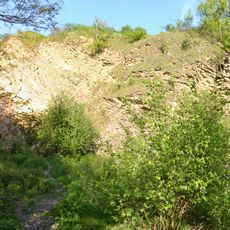
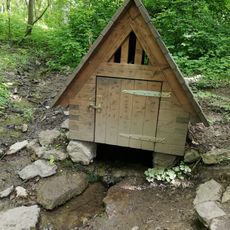
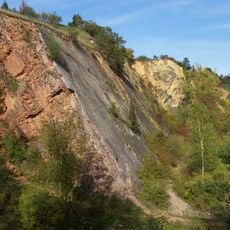
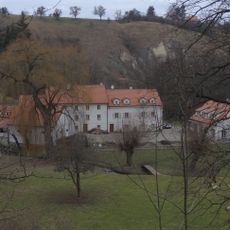
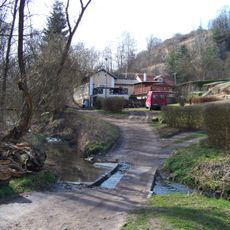
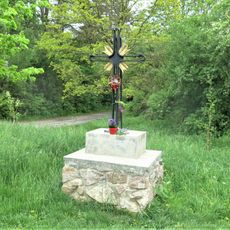
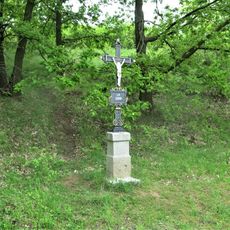
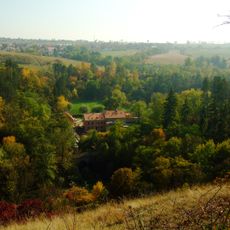
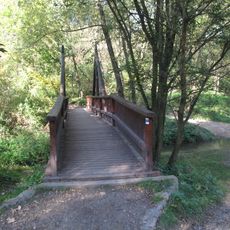
Černý lom, Abandoned limestone quarry in Prague, Czech Republic.
Černý lom is an abandoned limestone quarry in the Dalejské údolí valley near Prague-Řeporyje, at 307 m elevation. Its main wall, originally up to 275 m long and 30 m high, exposes dark Silurian limestones overlain by light high-grade Devonian limestones. Much of the quarry floor was later filled with mining waste from the Vokounka and Rokle quarries.
Quarrying at the site, originally called Kamčatka, ended around 1919. Most of the quarry floor was later filled with mining waste from the Vokounka and Rokle quarries on the opposite side of the Dalejské údolí. In 1923 the fossil collector František Hanuš (1860–1937) named it Černý lom after its dark Silurian limestones.
The quarry is named after its dark Silurian limestones; fossil collector František Hanuš (1860–1937) gave it the name Černý lom in 1923. Its western part, closer to the Mušlovka quarry, he called "Lobolitová stráň" (Lobolite Slope), where after spring thaws collectors could find lobolites of the genus Scyphocrinites as large as a small ball, with walls a few millimetres thick enclosing hollow chambers.
The quarry lies at 307 m above sea level in the Dalejské údolí valley near Prague's Řeporyje, in the Holyně cadastral area. The floor was largely filled with mining waste from the Vokounka and Rokle quarries, so the original 275 m length and 30 m wall are partly buried. Access is by the marked hiking trail 3063 through the valley.
The dark Silurian limestones were named Černý lom (Black Quarry) in 1923 by fossil collector František Hanuš (1860–1937). In the weathered pinkish Devonian limestones of the eastern wall lies the global Silurian–Devonian boundary, fixed at Klonk near Suchomast by the 1972 Montreal geological congress. Collectors find lobolites, the gas-filled floats of planktonic crinoids, in the scree.
The community of curious travelers
AroundUs brings together thousands of curated places, local tips, and hidden gems, enriched daily by 94,257 contributors worldwide.