Volarské menhiry, Stone circle in Volary, Czech Republic.
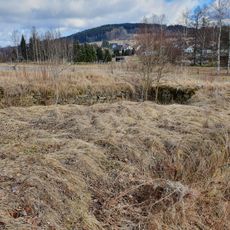
The Volarské menhiry is a roughly circular grouping of eleven light-coloured gneiss stones on the hill U dvou líp above Staré město near Volary. The stones range from 50 to about 130 cm in height, the largest weighing almost 500 kg. A taller central sighting stele is surrounded by stones set to form two intersecting pentagrams, with one pair marking north and south.
The eleven stones come from a large stone circle in the Krušné Mountains, less than 300 km away, where they stood until after the Second World War. That site disappeared as fields were consolidated and a road was built through its centre. Geologist and chemist Pavel Polák had the stones moved to Volary, and they were re-erected on 28 April 2007, the eve of Beltain.
The stones were re-erected on 28 April 2007, the eve of the Gaelic festival Beltain, which was celebrated with bonfires and the driving of cattle to pasture. The circle is laid out by the sun's positions at the summer and winter solstices, and the stones carry individual names.
The stones stand on a private but freely accessible plot beside the road on the edge of a field, about 700 m (15 minutes on foot) from Volary's square along the green-marked town trail toward Zelené Dvory. From the railway station it is roughly 1.5 km of gentle uphill walking, mostly northward. They are easiest to see outside winter, when snow does not bury them.
The stones were placed so that one menhir marks north and the opposite one south, fixing the circle's north–south axis. Their positions follow the sun at the summer and winter solstices and the Celtic feast of Beltain, held on the eve of 1 May.
The community of curious travelers
AroundUs brings together thousands of curated places, local tips, and hidden gems, enriched daily by 92,714 contributors worldwide.