Portage Viaduct, Railway bridge in Livingston County, United States.
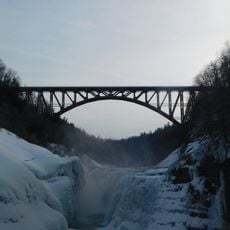
Portage Viaduct, also called Portage Bridge, was a single-track wooden trestle of the Erie Railroad crossing the Genesee River gorge at a height of 71 m (234 ft). Its 244 m (800 ft) deck rested on 14 rectangular trestle bents, the larger ones standing on sandstone ashlar pedestals 23 m by 4.5 m quarried from the riverbed and capped with limestone slabs. The wooden bents rose 58 m (190 ft), and the deck girder measured 4.3 m (14 ft).
Construction of the wooden Portage Bridge began on 1 July 1851, and the first locomotive crossed on 14 August 1852, with a formal opening on 25 August. It burned on the night of 5–6 May 1875 after a watchman could not extinguish the fire because of a stuck valve. The Erie Railroad decided four days later to rebuild in iron, and the new bridge was tested on 31 July 1875.
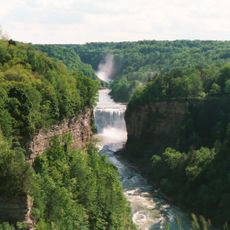
The bridge became a defining landmark for the region and shaped how people saw the Genesee Valley landscape. Visitors could experience 19th century engineering nestled within the natural scenery of the gorge.
Visitors can view the viaduct from observation areas near Letchworth State Park. The site is best explored on foot, and you should be prepared for uneven terrain in the gorge area.
The wooden structure used timber equivalent to about 100 hectares of conifer forest, and its 58-metre trestle towers were thought to have influenced early European iron railway viaducts. Fire was the feared risk: water tanks and watchmen were kept on the bridge, yet a stuck valve let the 1875 blaze spread.
The community of curious travelers
AroundUs brings together thousands of curated places, local tips, and hidden gems, enriched daily by 93,600 contributors worldwide.