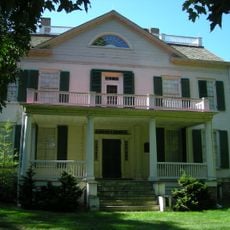
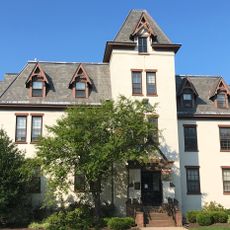
Ross Hall, Colonial farmhouse in Piscataway, New Jersey.
Ross Hall was a two-story brick farmhouse with a stone foundation and a gambrel roof, combining Georgian and Dutch colonial styles. Edward Antill built it around 1739 on his 370-acre estate near Raritan Landing, where he kept an orchard of 500 apple trees for cider. The house was destroyed by fire in 1957.
Edward Antill built the house around 1739–1740 on the 370-acre estate he inherited near Raritan Landing, after his marriage to Anne Morris. In 1768 the property passed to Dr. Alexander Ross, whose name it took. In July 1778 George Washington made it his headquarters after the Battle of Monmouth and ordered a feu de joie there for the second anniversary of independence. Rutgers University owned it in the 1950s; a fire damaged it in 1954 and it was destroyed in 1957.
The house takes its name from Dr. Alexander Ross, who bought the property in 1768 and died in 1775; his widow Sarah then married his assistant, Dr. Charles A. Howard, in 1778. Edward Antill's estate included an orchard of 500 apple trees, and the apples were pressed for cider at his distillery. After 1897 the building served as the clubhouse of the New Brunswick Golf Club until 1925.
The site is now part of the Rutgers University campus, so access is possible but limited to certain areas. Visitors should check ahead about hours since the grounds serve active university functions.
The house was destroyed by fire in 1957, but a parlor wall was saved and is to be shown in an educational wing of the Metlar-Bodine House Museum. A memorial stone at River Road and Sutphen Road marks the 1778 Independence Day parade.
The community of curious travelers
AroundUs brings together thousands of curated places, local tips, and hidden gems, enriched daily by 94,392 contributors worldwide.