Dearborn City Hall Complex, Colonial Revival government building in Dearborn, United States
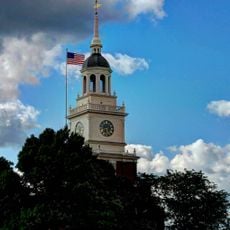
The Dearborn City Hall Complex consists of three connected structures with a central Colonial cupola and symmetrical brick facade. The buildings span about 300 feet along Michigan Avenue and house government offices, police facilities, and municipal courts within a coordinated architectural design.
The original city hall was built in 1921 from designs by Marcus Burrowes when the region was still called Springwells. A police and courts building was added in 1929, completing the complex with a U-shaped structure and limestone entrance designed by John Kasurin.
The complex's name traces the area's shifts: Springwells became Fordson in 1925, then merged into Dearborn in 1929. Clyde M. Ford, Henry Ford's cousin, was the first mayor of the consolidated city, serving 1929 to 1935; Orville L. Hubbard held the office from 1942 to 1978. A paved war memorial plaza sits on the grounds.
The complex fills nearly a full block on the north side of Michigan Avenue near downtown Dearborn, with the 1921 City Hall facing the avenue and the 1929 Police and Municipal Courts Building facing Maple Street. The 1981 concourse links the two at basement level. On the grounds are a landscaped public park, a small paved war memorial plaza and a surface parking lot.
The original building construction costs exceeded 200,000 dollars at the time, a substantial amount for a civic project of that era. This financial investment reveals how seriously Dearborn took creating a proper administrative center.
The community of curious travelers
AroundUs brings together thousands of curated places, local tips, and hidden gems, enriched daily by 92,609 contributors worldwide.