Motor Mill Historic District, Historic mill complex in Clayton County, Iowa, United States
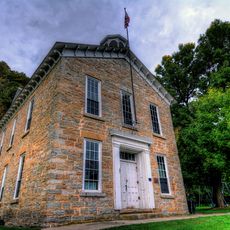
Motor Mill Historic District is a six-story limestone gristmill about 90 feet tall on the Turkey River southeast of Elkader. Its stone was quarried from the bluff above and lowered on wooden rails. Three walls are rounded stone and the fourth square cut; the flat north faces were meant for a woolen mill that was never built.
John Thompson, James Crosby and J.P. Dickinson formed a partnership to build a town, mill and businesses at Hastings Bottom on the Turkey River, naming it Motor. German stonemasons from Communia built the six-story gristmill, completed in 1869 and operating by 1870. Chinch bugs ruined wheat, a planned narrow-gauge railroad washed out and the 1883 flood took the dam; the partnership dissolved and a district court auctioned the property in 1891.
Legend holds that four German stonemasons from nearby Communia each built one wall of the mill, competing to show superior skill. Three walls are laid in rounded stone, while the fourth uses square cut stone. The north faces are flat because investors planned a woolen mill there that was never built.
The Clayton County Conservation Board acquired the site in 1983 and turned it into a park. The mill stands above the Turkey River southeast of Elkader, so expect uneven ground around the stone buildings and wear sturdy footwear. The mill's machinery was sold off in the early 1900s, so the interior is largely empty.
Stone for construction was transported from nearby bluffs using cable cars running on wooden rails, an engineering achievement of the 1800s. This clever system allowed workers to move heavy materials uphill.
The community of curious travelers
AroundUs brings together thousands of curated places, local tips, and hidden gems, enriched daily by 93,654 contributors worldwide.