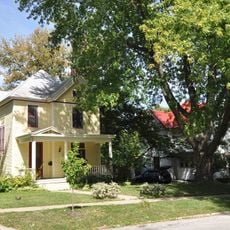
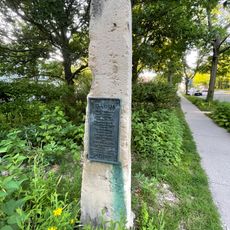
Oakes-Wood House, Italianate house in Iowa City, Iowa, United States
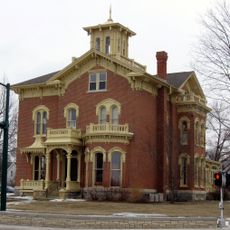
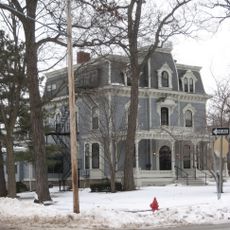
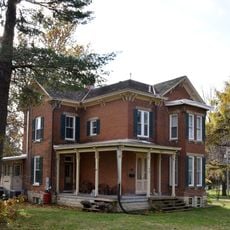
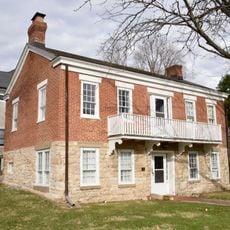
The Oakes-Wood House is a two-story brick residential building in Iowa City constructed in the Italianate style, featuring a distinctive T-shaped footprint. It displays typical characteristics of that architectural period: a low roof with wide eaves supported by decorative brackets and three tall brick chimneys.
The house was built in 1858 by Nicholas Oakes, a pioneer of local brick manufacturing, during the height of Italianate architecture in the United States. Grant Wood, a prominent artist, lived in the building from 1936 until his death in 1942 and created significant works there.
Grant Wood taught painting at the University of Iowa's School of Art while living here, and wrote Revolt Against the City, arguing for the value of regionalism in art. The house also displays a lithograph by James Claussen, who was born in Iowa City.
The house stands on East Court Street in the Longfellow Historic District, listed on the National Register in 1978 and made a contributing property of the district in 2002. It is a private residence, so visitors see the brick exterior, bracketed eaves and three chimneys from the street rather than the interior.
Grant Wood wrote Revolt Against the City while living here, setting out his case for regionalism in American art. He also taught painting at the University of Iowa's School of Art during these years, so the house links his writing and teaching as well as his painting and lithography.
The community of curious travelers
AroundUs brings together thousands of curated places, local tips, and hidden gems, enriched daily by 94,422 contributors worldwide.