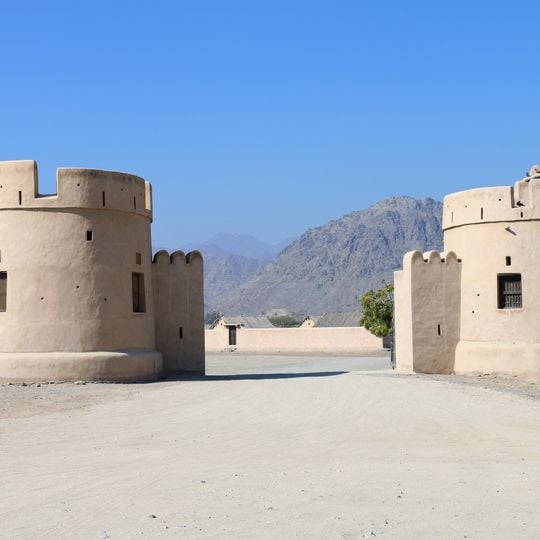
Fujairah Fort, 16th-century defensive castle in Fujairah, United Arab Emirates
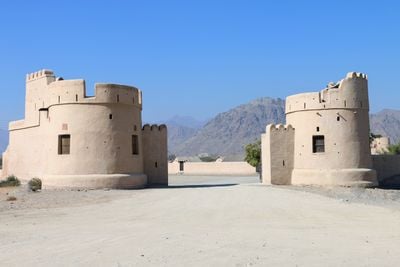
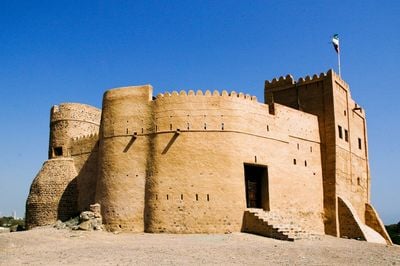
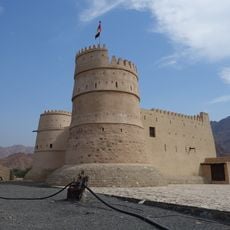
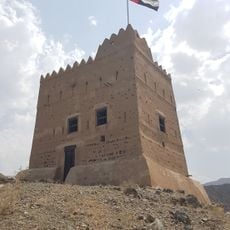
Fujairah Fort stands on a 20-metre rocky hill about 2 km from modern Fujairah and 1 km from the coast. Its walls of stone, gravel, mud, hay and plaster follow the uneven rock, so the plan is irregular. Three round watchtowers and one square tower connect by walls around a central hall; the ground floor holds a courtyard, one room and a main entrance, with stairs to an upper floor with a majlis and a roof ringed by crenellations.
Radiocarbon analysis dates the fort's construction to between 1500 and 1550, with rebuilding between 1650 and 1700. Wahhabists occupied it from 1808 to 1810 before local forces drove them out, and it served as a prison into the 1900s. In 1925 the British Navy's HMIS Lawrence bombarded it, destroying three towers; the fort stood neglected until restoration in 1997–2000.
Locals call it Qal'at al-Fujairah. The fort's fame rests on its irregular plan, shaped by the rock beneath it rather than any fixed geometric scheme, and on its role in resisting Portuguese and English attacks, as recorded in local histories. The Fujairah Administration of Antiquity and Heritage restored it between 1997 and 2000 using the original materials.
Morning and late afternoon visits work best since the midday heat can be intense on the exposed grounds. Wear sturdy shoes as you will walk over uneven stone surfaces and rocky terrain.
The fort's layout follows the natural rock formations beneath it rather than following a regular geometric plan. This unusual approach to construction created an asymmetrical shape that fits perfectly within the landscape.
The community of curious travelers
AroundUs brings together thousands of curated places, local tips, and hidden gems, enriched daily by 94,111 contributors worldwide.