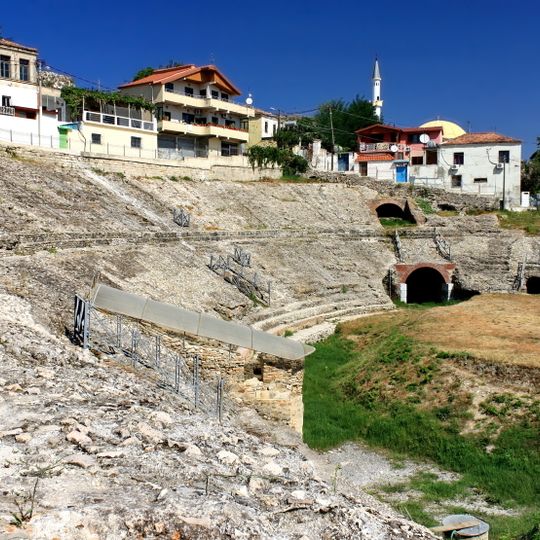
Roman amphitheatre of Durrës, Roman amphitheatre in Durrës, Albania.
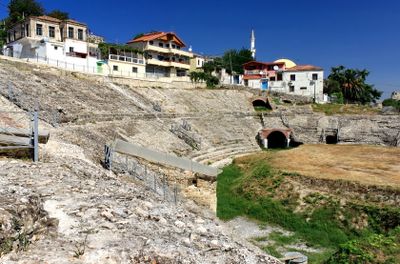
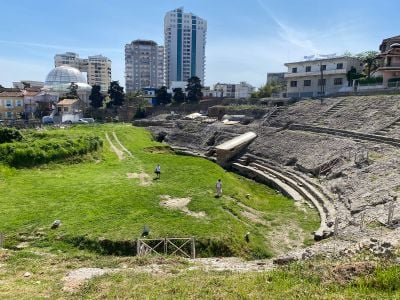
The Amphitheatre of Durrës is an elliptical Roman structure with axes of 132.4 and 113.2 metres, built into a sloping hillside so that about two-thirds rests on the hill. Its arena measures 61.4 by 42.2 metres, and the seating rose on white-clad tiers to a height of about 20 metres. Staircases and galleries run through different levels, and two brick-red arched openings are set into the curved face.
Construction began under Trajan in the early 2nd century AD, and the amphitheatre hosted performances until the 4th century, when the earthquake of 345/346 likely closed the gladiatorial games. An early Christian chapel with frescoes was built on the structure in the second half of the 4th century, gaining mosaics in the 6th century; a medieval chapel with frescoes followed in the 13th century. After the Ottoman occupation a wall was built nearby and the monument was covered over in the 16th century. Excavation came in the 1960s under Vangjel Toci and in the 1980s under Lida Miraj.
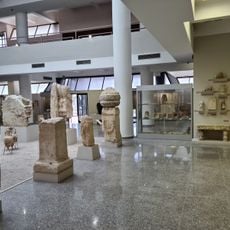
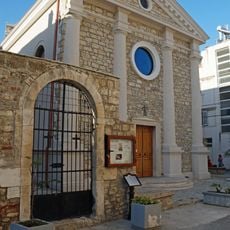
An early Christian chapel was built on the amphitheatre in the second half of the 4th century, first decorated with frescoes and given mosaics in the 6th century; a medieval chapel with frescoes followed in the 13th century. The mosaic chapel is preserved, and the site now serves as a museum and as the stage of the International Film Summerfest of Durrës.
The amphitheatre stands in the city centre, about 350 metres from the sea, with its lower arena set roughly 5.5 metres above sea level and two-thirds of the structure built into the hillside. Parts of the arena are now covered by modern housing, so access is limited to excavated sections. The chapel with mosaics is preserved inside.
This is the largest preserved Roman amphitheater in the Balkan Peninsula, setting it apart from other remains of this period in the wider region. The scale and preservation offer rare insight into Roman engineering across the eastern territories.
The community of curious travelers
AroundUs brings together thousands of curated places, local tips, and hidden gems, enriched daily by 92,586 contributors worldwide.