Sev Berd, 19th-century fortress in Gyumri, Armenia
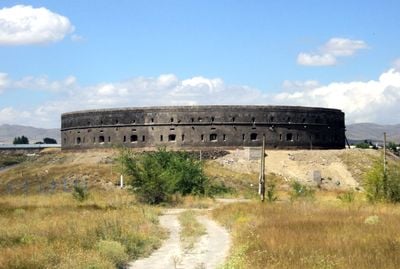
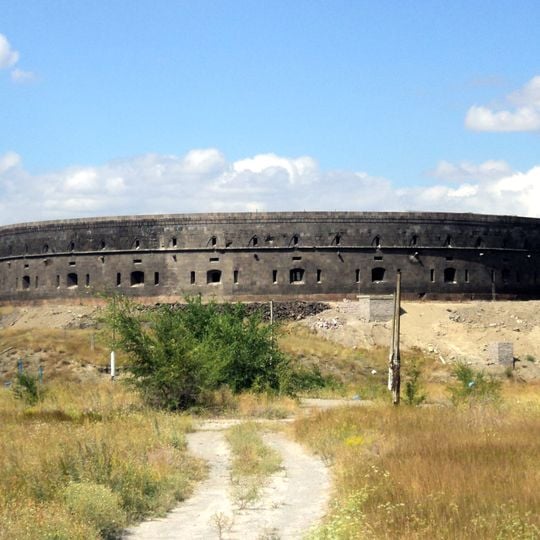
Sev Berd is a round fortress of dark basalt begun in 1834 on a hill in Gyumri, about 8 km from the Turkish border. Its long curved wall has two levels: tall narrow arched openings below, a row of small rectangular slots above, and a flat unroofed top. A dirt path through dry grass and shrubs runs along the sloped bank beneath it.
Construction began in 1834 under Emperor Nicholas I as a response to potential Turkish threats following the Russian-Persian War. The fortress was part of Russia's strategy to strengthen its southern frontier in the Caucasus region.
The fortress is known in Armenian as Sev Berd, meaning Black Fortress, after the dark basalt used to build it. Excavations on the hill revealed that this was the city's oldest inhabited area, with burials from the 8th to 6th centuries BC found inside the courtyard. German archaeologist Geosner dug beneath the fortress in 1900, and Kharatyants worked here in 1907-1908.
The location sits on a hillside with good views across the city and is relatively easy to reach, though the climb up can be tiring. Visitors should be prepared for uneven ground inside the fortress and dress appropriately depending on the season.
Excavations inside the fortress courtyard uncovered tombs dated to the 8th–6th centuries BC, and the surrounding plain from the tower to the far end of the fort is largely a burial ground. Researchers dug here from about 1875, and in 1900 the German archaeologist Geosner excavated beneath the Black Fortress.
The community of curious travelers
AroundUs brings together thousands of curated places, local tips, and hidden gems, enriched daily by 92,720 contributors worldwide.