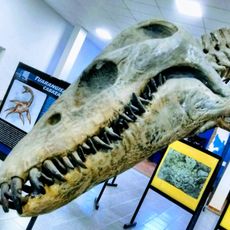
Allen Formation, Geological formation in Neuquén Province, Argentina.
The Allen Formation is a geological layer in Neuquén Province containing sedimentary rocks with fossilized remains of dinosaurs and other animals from the Late Cretaceous period. The deposits consist of clay and sandstone with limestone and mineral-rich layers.
The Allen Formation was first defined by Roll in 1939, and a new type locality and section were later established near El Caracol, where the base and top contacts are clearer. Uliana and Dellapé defined its stratotype in 1981 in the eastern Bajo de Añelo. Its base is marked by a sharp contact with the Anacleto Formation, often with a greenish bleached band, and its top passes without transition into the claystones of the Jagüel Formation.
The formation's name comes from the Allen field area of Río Negro, and its fossil content has been studied since the early 20th century. Wichmann grouped these beds among the "Estratos con dinosaurios", and Groeber called them "Senoniano lacustre" and "Loncochense". Abelisaurus comahuensis and Pellegrinisaurus powelli were long attributed to the Allen Formation before being reassigned to the Anacleto Formation.
The formation's type section lies near El Caracol, east of the Bajo de Añelo, where the base and top contacts are clearly exposed. Outcrops also run along the right bank of the Neuquén River from Planicie Banderita to Barda del Medio, and south of the Auca Mahuida volcanic field. The base is recognised by a sharp contact and a greenish bleached band against the Anacleto Formation.
The formation's mammal fauna is known from just seven teeth, which document several species. Abelisaurus comahuensis and Pellegrinisaurus powelli were once attributed to the Allen Formation, but the dinosaur-bearing outcrops near Cinco Saltos and Lago Pellegrini were later reassigned to the Anacleto Formation.
The community of curious travelers
AroundUs brings together thousands of curated places, local tips, and hidden gems, enriched daily by 93,937 contributors worldwide.