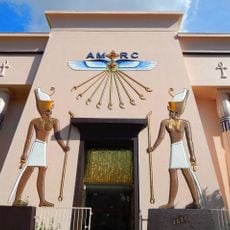
Museu Egípcio e Rosacruz, Egyptian and Rosicrucian Museum in Bacacheri, Brazil
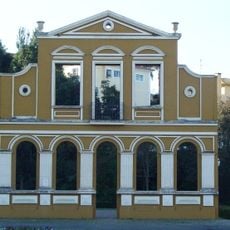
Museu Egípcio e Rosacruz is a museum in the Bacacheri neighbourhood of Curitiba, maintained by the Rosicrucian Order AMORC and linked to the Grande Loja da Língua Portuguesa. Its collection of more than 700 items consists mainly of replicas of Egyptian pieces from several periods, made by Brazilian artists such as Eduardo D'Ávila Vilela, Luis César Vieira Branco, Tathy Zimmermann, Christopher Zoellner, Moacir Elias Santos and Aylton Tomás.
The Curitiba museum opened on 17 October 1990 after the artist Eduardo D'Ávila Vilela donated his Egyptian artefacts to the Rosicrucian Order AMORC and proposed a space to house them. Its roots lie in the Rosicrucian Egyptian museum in San Jose, California, whose collection grew after Harvey Spencer Lewis's 1929 trip to Egypt and whose new buildings opened in November 1966.
The museum belongs to the Rosicrucian Order AMORC, which founded its first Egyptian collection in San José, California, in 1928; the Curitiba branch opened in 1990. Its name links the Egyptian theme to the Rosicrucian order that runs it. The more than 700 items are mostly replicas made by Brazilian artists, among them Eduardo D'Ávila Vilela, who donated his own Egyptian artifacts and proposed creating the space.
The museum is in the Bacacheri neighbourhood of Curitiba and is open to the public, receiving hundreds of visitors each year. It also serves as a base for educational visits and for researchers in Egyptology, so allow time to read the labels on the replica pieces and the Tothmea display.
The museum houses Tothmea, an authentic mummy of an 18th dynasty Egyptian singer, a rare find in South America. This genuine artifact is one of only two real Egyptian mummies in the entire country.
The community of curious travelers
AroundUs brings together thousands of curated places, local tips, and hidden gems, enriched daily by 93,860 contributors worldwide.