Gruta de Santa Luzia park, Environmental park in Mauá, Brazil
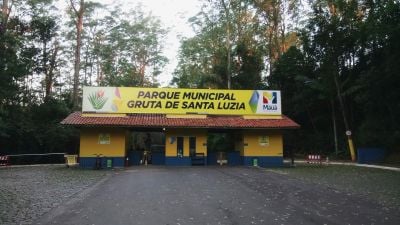
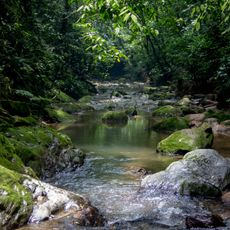
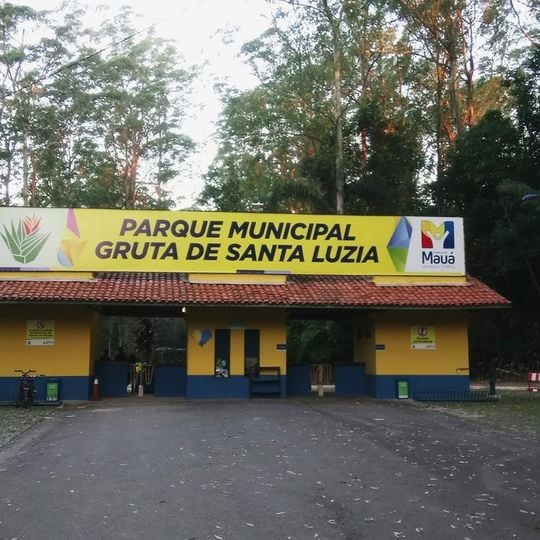
Gruta de Santa Luzia is a 450,899.68 m² municipal park in Mauá, made up of remaining native Atlantic Forest and eucalyptus reforestation areas. Inside it, a natural cave shelters one of the springs of the Tamanduateí River. At the entrance, a single-story structure with a yellow facade and dark blue base carries the sign "PARQUE MUNICIPAL GRUTA DE SANTA LUZIA" and geometric shapes beside the word "Mauá".
The area was probably part of a Benedictine farm between the 16th and 18th centuries, later becoming Sítio Itapeva or Sítio da Pedra Grande, where granite quarries drove the local economy. Cutters called escarpelinos washed stone-splintered eyes in the spring inside the cave, invoking Santa Luzia, whose image was carried in procession through Mauá and placed there. In early 1974 the municipality created the Parque da Gruta; a 1992 IBAMA-funded renaming made it Parque Ecológico de Mauá.
The cave holds a statue of Saint Lucy, patron saint of eyes, carried in procession through Mauá's neighbourhoods and kept there for years. Quarrymen called escarpelinos washed stone splinters from their eyes in the spring water and invoked her protection. The park's name comes from this grotto.
The park covers 450,899.68 m² and borders a water-source protection area, so access follows the rules of a conservation unit. Weekdays draw mostly visitors over 30 for physical activity, while weekends bring families; school groups join guided trails by appointment. The spring water is unfit for drinking: a study by Centro Universitário Fundação Santo André (2007–2008) found microorganisms from human faeces about 300 m from the grotto.
The cave itself is a natural cavity sheltering one of the springs of the Tamanduateí River. Quarrymen called escarpelinos or canteiros washed stone splinters from their eyes in this spring water, calling on Santa Luzia, the Catholic patron saint of eyes. A statue of her was carried in procession through Mauá's neighbourhoods and placed in the cave, where it stayed for several years. The cave's speleological mapping was done by the Grupo Pierre Martin de Espeleologia.
The community of curious travelers
AroundUs brings together thousands of curated places, local tips, and hidden gems, enriched daily by 94,238 contributors worldwide.