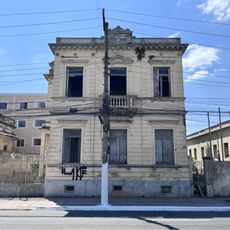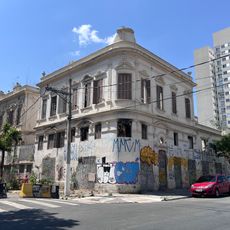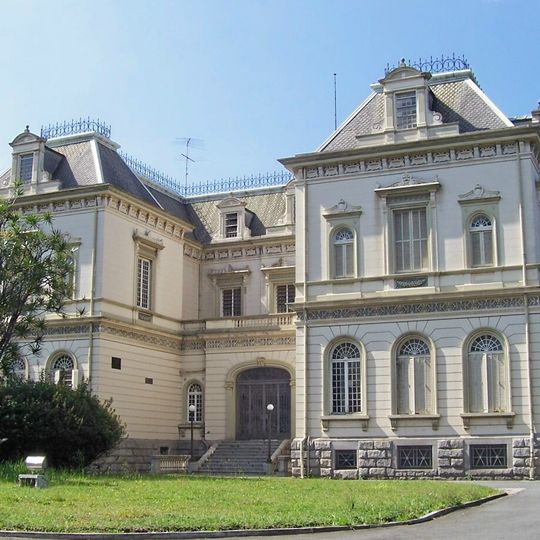
Campos Eliseos Palace, Historical palace in Campos Elísios, São Paulo, Brazil.
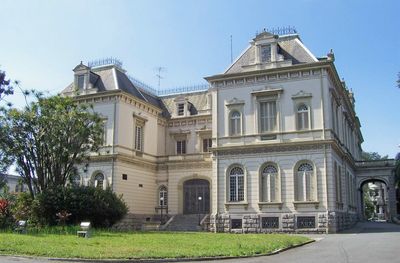
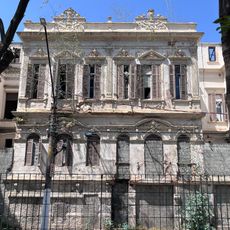
The Campos Elíseos Palace is a four-storey, 4,000-square-metre building of light grey stone blocks, designed by Matheus Häusler and inspired by the Château d'Écouen in France. Its right block has a round-arched entrance below a fanlight, reached by broad stone steps, with three tall round-arched windows on the ground floor and three rectangular windows above, each with a balustraded balcony and small pediment. A projecting left wing with rectangular windows carries a dark grey roof topped by iron cresting, and a low stone base and lawn sit in front.
Designed by German architect Matheus Häusler, the palace was built between 1890 and 1899 as the residence of coffee grower Elias Antônio Pacheco e Chaves, who died in 1903. His family sold it to the state in 1911, and from 1912 it housed São Paulo's governors, starting with Rodrigues Alves. Revolutionaries occupied it for about 20 days in 1924, and it was bombarded again in 1932.
The neighbourhood and the palace both take their name from the Champs-Élysées in Paris, a reference chosen by the developers of this late-19th-century district. The coffee grower Elias Antônio Pacheco e Chaves, who commissioned the building, also worked on the Viaduto do Chá. The name Campos Elíseos was later extended to the palace itself, which became the seat of the São Paulo state government in 1915.
The palace stands on Avenida Rio Branco near the Princesa Isabel bus terminal, in the central zone of São Paulo. Since 1915 high walls, now about 2 metres tall, hide the building from pedestrians, so the stone facade is best seen from across the avenue. Restoration finished in 2017 brought accessibility and safety adaptations.
The palace's interior once held mirrors from Venice, porcelain doorknobs from Sèvres, terracotta from Italy, and locks and hinges from the United States, all imported for Elias Chaves. During the 1967 roof fire, first lady Maria Sodré carried artworks out of the building. The façade was rebuilt between 2008 and 2010 at a cost of about 3.65 million reais.
The community of curious travelers
AroundUs brings together thousands of curated places, local tips, and hidden gems, enriched daily by 92,963 contributors worldwide.