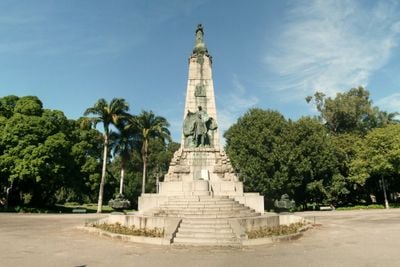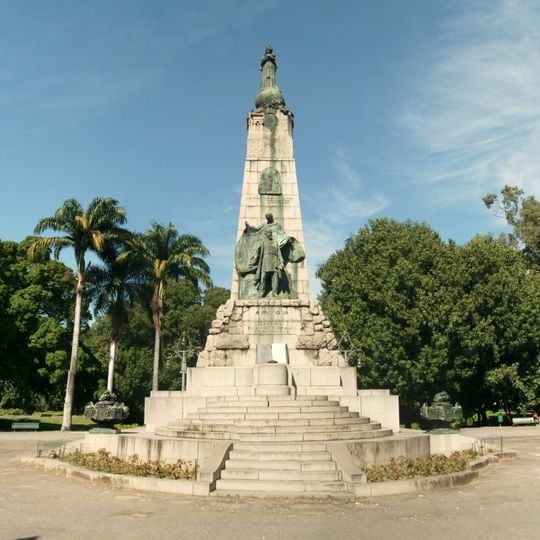
Campo de Santana, Public park in Centro district, Rio de Janeiro, Brazil.
Campo de Santana is a park in downtown Rio de Janeiro, divided in two by Avenida Presidente Vargas. On one side stand the Palácio Duque de Caxias and the Panteão Duque de Caxias; on the other lie the gardens landscaped by Auguste François Marie Glaziou, completed in 1880. Its paths pass rocaille bridges imitating tree trunks, four iron Jovem Europa fountains of 1888, and a set of monuments, among them the Quatro Estações marbles inaugurated in 1906.
The grounds took shape in the 1870s as a landscaped garden and witnessed key moments in Brazilian history. It was here that the nation declared itself a republic in 1889 and where the Emperor was acclaimed in 1822.
The name comes from the Church of Santana, built here in 1753 and demolished in 1854 for Brazil's first urban railway station. Four wooden kiosks installed under mayor Pereira Passos, among the last of their kind in the city, still stand in the park. The Praça da República is also where the Independence Day parade grandstand is set up.
The park sits in the heart of Rio and is easy to reach on foot, with wide paths for exploring. Visitors are best served arriving early in the day to enjoy the quiet and get closer to the wild animals.
The park was once the site of bullfights, popular spectacles until Mayor Francisco Marcelino de Sousa Aguiar banned them by decree in 1907. Today agoutis, wild ducks and peacocks move among the trees and rocaille bridges of Glaziou's 1880s garden.
The community of curious travelers
AroundUs brings together thousands of curated places, local tips, and hidden gems, enriched daily by 92,789 contributors worldwide.