Zeppelin Mast, Historic airship mooring tower in Jiquiá, Recife, Brazil
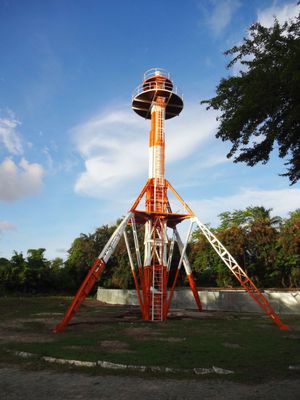
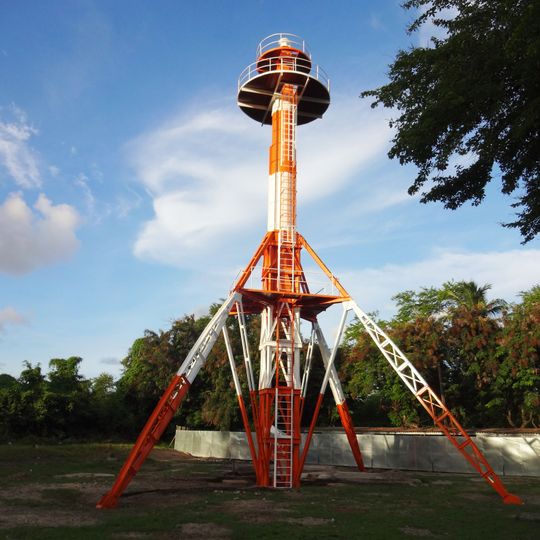
The Zeppelin Tower in Jiquiá is a metal mast painted in alternating orange and white bands, its four slender legs splayed outward and braced by white lattice struts. Above the legs a vertical shaft holds a straight ladder up to a wide circular railed platform, with a smaller square deck between the legs below. The 1930 tower measured 16.5 m; it was replaced in 1936 by a 19.5 m structure reinforced for the Hindenburg.
Built in 1930, the mast became Recife's anchor point for German airship operations crossing the Atlantic. It served as a docking station for famous aircraft like the Graf Zeppelin and Hindenburg during their intercontinental journeys.
The name Torre do Zeppelin recalls the airships that docked here; the site sits in Jiquiá, the former Campo do Jiquiá. The Condor Syndicate controlled ticket sales for the Recife stop, and in April 1936 conductor Heitor Villa-Lobos boarded the LZ-129 Hindenburg here bound for Europe. The tower now stands in Jiquiá Park beside the World War II bunkers restored with it in 2013.
The tower stands in Jiquiá Park, in Recife's Jiquiá neighbourhood, and can be seen from the surrounding streets. The park also holds the World War II bunkers restored alongside the tower in 2013. The metal structure is outdoors, so visits depend on weather and on the park being open.
This is the last remaining airship mooring mast of its kind in the world, preserving a rare testimony to the age of passenger airship travel. The structure marks a brief but influential moment in aviation history before newer transportation methods took over.
The community of curious travelers
AroundUs brings together thousands of curated places, local tips, and hidden gems, enriched daily by 93,860 contributors worldwide.