Golden Gate Highlands National Park, National park in Free State, South Africa.
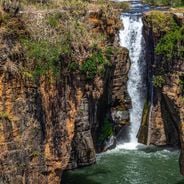
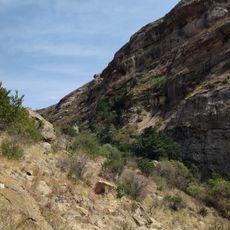
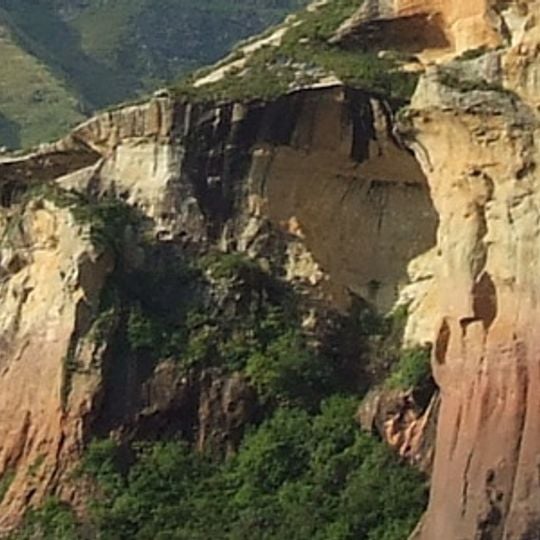
Golden Gate Highlands National Park protects deeply eroded sandstone cliffs and outcrops in the Rooiberge of the eastern Free State, including the Brandwag rock. The cliffs are made of the Clarens Formation, 140 to 160 m thick, with horizontal bands of cream, ochre and orange; the basalt of the Drakensberg Formation caps the summits. Ribbokkop, the highest peak in the Free State at 2,829 m, rises in the south, and the Caledon River forms the southern boundary.
In 1963, 47.92 km² was proclaimed a national park to protect the sandstone scenery. It was enlarged to 62.41 km² in 1981 and to 116.33 km² in 1988. The merger with QwaQwa National Park, completed in 2007, brought the total area to 340 km².
The park's caves and rock shelters hold San rock paintings, sacred reminders of the art of the San people. The sandstone overhangs of the Clarens Formation, such as the Brandwag rock, provided the sheltered surfaces these paintings were made on.
The park lies 320 km from Johannesburg near Clarens and Kestell, with the northern entrance at Clarens. Overnight stays are at Glen Reenen and Brandwag rest camps; Glen Reenen has caravan and campsites with all amenities, and the refurbished Golden Gate Hotel is managed separately by SANParks. June to August is dry and sunny, while October to April brings showers, hail and thunderstorms, and winters can have thick snowfalls.
The oldest dinosaur embryos ever found were discovered in the park in 1978: fossilised Massospondylus foetal skeletons inside Triassic eggs, 220 to 195 million years old. More of these eggs have since been found here. The red mudstone of the Elliot Formation, visible below the sandstone cliffs, is where many dinosaur fossils have been unearthed.
The community of curious travelers
AroundUs brings together thousands of curated places, local tips, and hidden gems, enriched daily by 93,011 contributors worldwide.