Bwindi Impenetrable National Park, National park in Kanungu District, Uganda.
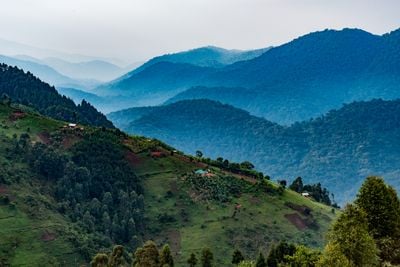
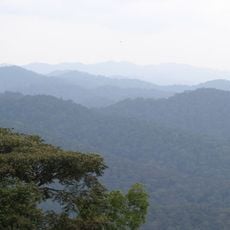
Bwindi Impenetrable National Park covers 321 km² of lowland and montane forest along the Democratic Republic of the Congo border. Its terrain rises from 1,190 m to 2,607 m at Rwamunyonyi Hill, with narrow valleys cut by rivers and steep hills. The forest is a patchwork of dark green canopy and lighter cultivated plots outside the boundary, crossed by narrow dirt paths.
Two forest blocks were gazetted as Crown Forest Reserves in 1932, merged and enlarged in 1942 as the Impenetrable Central Crown Forest, and made an animal sanctuary in 1964. In 1991 the reserve became Bwindi Impenetrable National Park; UNESCO listed it in 1994. The Batwa were evicted when it became a national park, and gorilla tracking began in April 1993.
The name Bwindi comes from a local word for darkness, referring to the forest's dense canopy. The Batwa, evicted when the park was declared in 1991, no longer enter or use its resources. Every tour group is accompanied by an armed guard, a practice introduced after the 1999 attack at the park headquarters.
Visitors should prepare for demanding hikes on steep and muddy trails, so proper footwear and physical fitness are essential for the experience. The best time to visit is during dry seasons when the forest paths are more accessible.
The park is home to roughly half of the world's mountain gorilla population, making it one of the most critical places for this species. This concentration makes every conservation effort here crucial for the global survival of these primates.
The community of curious travelers
AroundUs brings together thousands of curated places, local tips, and hidden gems, enriched daily by 93,201 contributors worldwide.