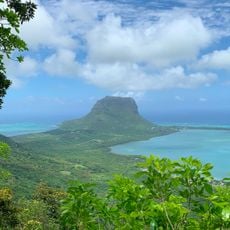
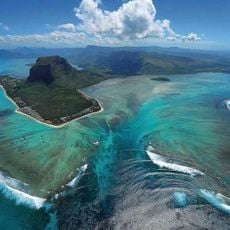
Le Morne Brabant, Mountain peak in southwestern Mauritius.
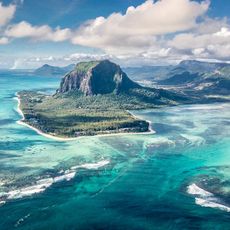
Le Morne Brabant is a basaltic monolith 556 metres high on a peninsula at the southwestern tip of Mauritius. Its summit covers over 12 hectares, and its steep slopes hold many caves and overhangs. The upper part is bare rock in brown, grey and reddish-purple, with a lighter band running diagonally down the face; dense dark-green forest covers the lower slopes and base.
The mountain is named after the Dutch East India Company ship Brabant, which ran aground here on 29 December 1783. In the early 19th century escaped slaves took refuge on its slopes. On 1 February 1835, when slavery was abolished, a police expedition sent to inform them was misunderstood, and many leapt to their deaths. UNESCO inscribed the site in 2008.
The mountain's name comes from the Dutch East India Company ship Brabant, which ran aground here on 29 December 1783. Since 1987, 1 February has been marked by Mauritian Creoles as the Annual Commemoration of the Abolition of Slavery. A monument bears lines from Richard Sedley Assonne's poem "Le Morne Territoire Marron": "There were hundreds of them, but my people the maroons chose the kiss of death over the chains of slavery."
The climb is steep and demanding, taking several hours, so starting early in the morning is advisable to finish before afternoon heat sets in. Bring plenty of water, wear sturdy hiking boots, and be prepared for exposed terrain with few shaded spots.
The optical illusion of an underwater waterfall off the coast is created by sand and silt sliding down the underwater slope of the island's shelf into deep ocean. It is best seen from a helicopter or on satellite images, not from the mountain itself.
The community of curious travelers
AroundUs brings together thousands of curated places, local tips, and hidden gems, enriched daily by 93,098 contributors worldwide.